
From Market Entry to Market Success: What Companies Must Get Right After Entering Vietnam
19/01/2026
From Market Entry to Market Success: What Companies Must Get Right After Entering Vietnam
Market Entry Is Not the Finish Line
For many foreign companies, successfully entering Vietnam feels like the hard part. The license is issued, the entity is registered, and the bank account is open. However, the true test of Vietnam market entry execution begins the moment operations go live.
To minimize initial capital exposure, learn how to build a structured Vietnam market entry discovery phase.
Vietnam market entry failures rarely happen at the setup stage. They happen after entry, when companies struggle to execute, localize, and scale in a fast-moving, relationship-driven market. Without operational readiness and a clear execution roadmap, early momentum is quickly lost.
The Vietnam Market Entry Execution Gap Most Companies Underestimate
| Setup Phase (Entry) | Execution Phase (Success) |
|---|---|
| Obtaining the IRC/ERC Licenses | Implementing Local KPI Reporting |
| Opening a Capital Account | Managing Cash Flow & Tax Compliance |
| Finding a Factory/Office Space | Optimizing Supply Chain Performance |
| Initial Legal Structuring | Vietnam Market Entry Execution & Scaling |
Explore Our Vietnam Market Entry Packages
Vietnam rewards speed, adaptability, and local fluency. What worked during market research or legal setup often does not work once operations begin.
Common post-entry execution gaps include:
- Misaligned staffing and unclear local roles
- Supplier and partner dependencies without performance controls
- Compliance handled reactively instead of systematically
- Sales pipelines that stall due to weak localization
- Cost structures that drift without early visibility
These gaps do not appear dramatic on day one. They compound quietly and become expensive to fix later.

A Framework for Post-Vietnam Market Entry Execution Success
Why “Local Presence” Is Not the Same as Local Capability
Having an office or factory in Vietnam does not automatically create local capability. Execution requires systems, people, and decision frameworks that fit Vietnam’s operating reality.
Companies that perform well typically:
- Build management layers that bridge HQ and local teams
- Establish clear operating KPIs from the first quarter
- Formalize partner governance instead of relying on trust alone
- Design processes around Vietnam’s regulatory and labor environment
Those that do not often find themselves reacting instead of leading.
Operational Readiness Determines Speed to Revenue
The faster a company stabilizes operations, the faster it reaches predictable revenue.
Operational readiness means:
- Clear authority and escalation paths
- Reliable local reporting and financial visibility
- Workforce structures aligned with growth plans
- Compliance embedded into daily operations
This is especially critical for SMEs, where leadership bandwidth is limited and early missteps carry disproportionate risk.
Scaling in Vietnam Requires a Different Playbook
Scaling in Vietnam is not a linear extension of market entry. It is a shift in mindset.
As companies grow, they must transition from:
- Founder-led decisions to structured management
- Opportunistic hiring to workforce planning
- Informal supplier relationships to enforceable contracts
Those who prepare early scale faster and with fewer disruptions. Those who delay often face operational bottlenecks at precisely the moment growth accelerates.
How Structured Execution Reduces Risk and Increases ROI
Companies that approach Vietnam with an execution-first mindset see clearer outcomes:
- Faster stabilization of operations
- Lower compliance and people risk
- Stronger partner performance
- More predictable growth trajectories
This is why execution readiness has become a core focus of successful Vietnam expansions, not an afterthought.
Turning Entry into Long-Term Success
Vietnam remains one of Asia’s most attractive growth markets. But success belongs to companies that move beyond entry and focus on how they operate, not just where.
Structured execution, operational discipline, and local insight are what turn a Vietnam presence into a Vietnam advantage.
For companies serious about long-term performance, the work truly begins after entry.
Market Entry Execution FAQ
- What is a low risk discovery phase for Vietnam market entry? A low risk discovery phase is a preliminary testing stage. It allows foreign investors to validate local demand, analyze compliance costs, and audit suppliers before committing major capital or establishing a formal legal entity.
How long does it take to secure a corporate investment certificate in Vietnam? The official statutory timeline ranges from 15 to 30 business days. Total operational setup typically requires 3 to 6 months to finalize local site leasing and compliance steps.
What are the primary compliance risks for new companies in Vietnam? The main risks involve shifting regulatory frameworks, local partner licensing limitations, intellectual property protection gaps, and specialized operational compliance within individual industrial zones.
Explore Our Vietnam Market Entry Packages

Related posts

Vietnam IT Outsourcing: How AI is Transforming the Industry
Vietnam IT Outsourcing: How AI is Transforming the Industry The landscape of Vietnam IT outsourcing

Vietnam Industrial Parks 2026: The Strategic FDI Playbook
Insights from the IMC 2026 keynote panel on navigating site selection, technical commissioning, and ESG
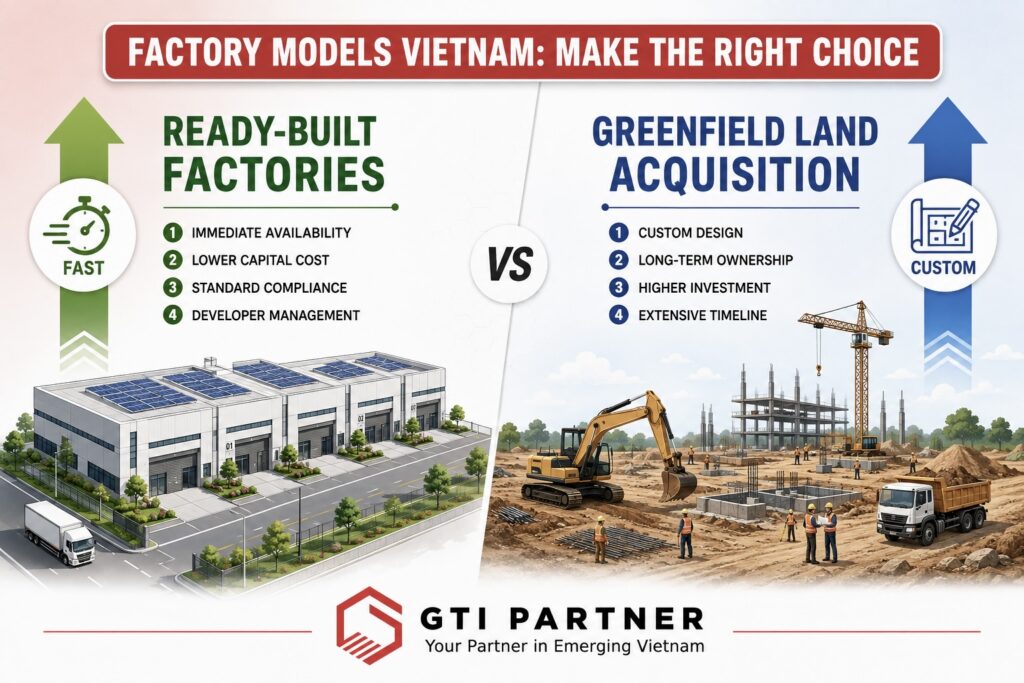
Ready-built factories vs greenfield land acquisition: Choosing the right model in Vietnam
Ready-built factories vs greenfield land acquisition: Choosing the right model in Vietnam When expanding manufacturing

Vietnam’s next generation of industrial parks: What foreign investors need beyond land and infrastructure
Vietnam’s next generation of industrial parks: What foreign investors need beyond land and infrastructure When
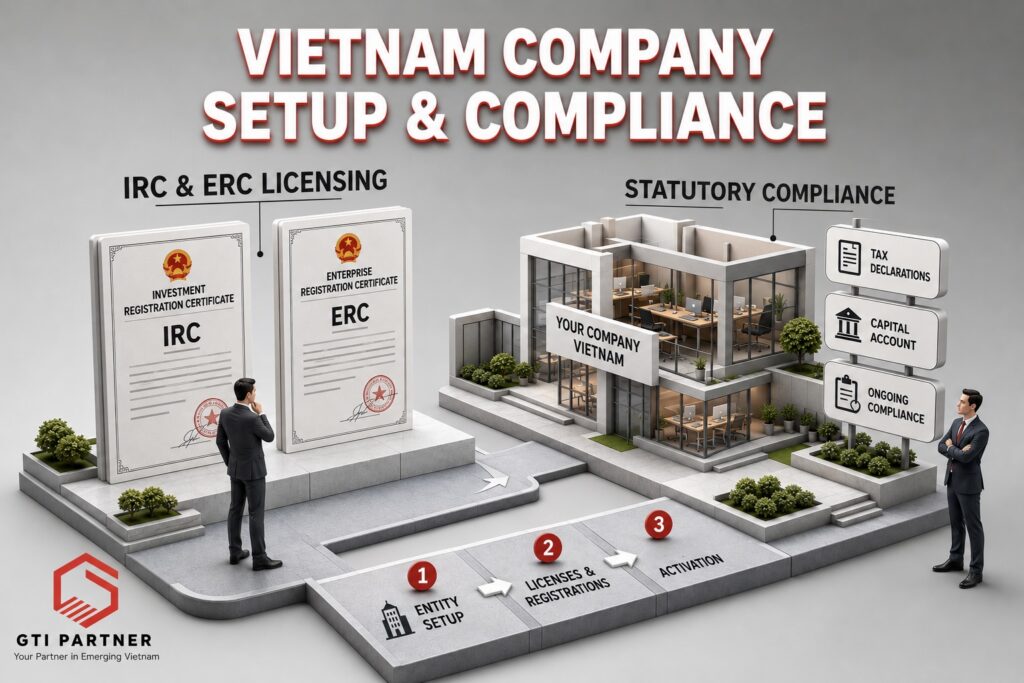
Company registration in Vietnam under the 2026 investment law
Company registration in vietnam under the 2026 investment law Starting a business in Southeast Asia