
Exploring Vietnam Is Not Entering Vietnam: Why SMEs Get Stuck Between Interest and Execution
12/01/2026
Vietnam Market Entry Strategy: Moving from Exploration to Execution
Vietnam remains one of Asia’s most attractive growth markets for global SMEs. Strong GDP growth, a young workforce, and expanding manufacturing capacity make the opportunity clear. However, building a successful vietnam market entry strategy requires more than just high-level research; it requires a decisive, structured transition from exploration to active implementation.
Yet many companies never move beyond “exploring” Vietnam.
They commission studies, attend trade missions, speak with advisors, and hold promising meetings. Months pass. Sometimes years. Despite genuine interest and real effort, no entity is formed, no team is on the ground, and no revenue is generated.
This is not a failure of ambition.
It is a failure of transition.
The Gap in Your Vietnam Market Entry Strategy
Most SMEs assume a market expansion path is linear:
Research → Decision → Setup → Growth
In reality, there is a critical missing stage between research and setup. This is the phase where intent must be translated into operational readiness.
What typically happens instead:
- Market research remains theoretical and disconnected
- Advice is fragmented across multiple uncoordinated providers
- Internal deployment teams lack local execution capacity
- Entry decisions are postponed due to unmitigated perceived risk
The company remains active, but it is not advancing.

Why “Exploration Mode” Becomes Expensive
Remaining in exploration mode feels safe. There is no legal exposure, no local payroll footprint, and no fixed presence. However, this prolonged phase creates steep hidden costs:
- Repeated consulting and advisory fees without tangible assets
- Lost first-mover market advantages
- Missed strategic partnerships and localized distributor opportunities
- Internal operational fatigue and stalled leadership alignment
Most importantly, competitors who commit early begin learning faster and adapting locally, while others are still debating basic entry models.
Information Does Not Equal Operational Readiness
One of the most common misconceptions is that sufficient information leads automatically to a successful launch.
In competitive markets, long-term commercial success depends less on what you know and more on:
- How entry decisions are structured
- Who executes them on the ground locally
- How financial and legal risk is controlled during early stages
Without a defined scope, clear operational ownership, and an aggressive timeline, even the best data insights remain unused.
What Successful Market Entrants Do Differently
Companies that successfully establish a footprint do not rush. But they also do not linger.
They move through clear, practical phases:
- Validate the opportunity with local, execution-focused input
- Commit through transparent legal and operational structuring
- Execute with on-the-ground coordination and accountability
- Scale up operations once systems and local partners are tested
Each phase must produce defined outputs, not just high-level recommendations.
Executing Your Vietnam Market Entry Strategy
The difference between stalled exploration and real progress is structure.
When expansion is treated as a defined program with clear deliverables, SMEs gain:
- Clear decision milestones
- Predictable budget control
- Faster internal board alignment
- Reduced execution risk
This is why leading firms increasingly choose structured entry solutions that combine high-level strategy, legal configuration, local execution, and operational support into practical, outcome-driven programs.
Final Thought
Establishing a regional footprint does not require blind commitment.
But it does require decisive transition.
Exploration is valuable. Active entry is transformative.
The companies that succeed are those that know exactly when to move from one to the other.

Related posts
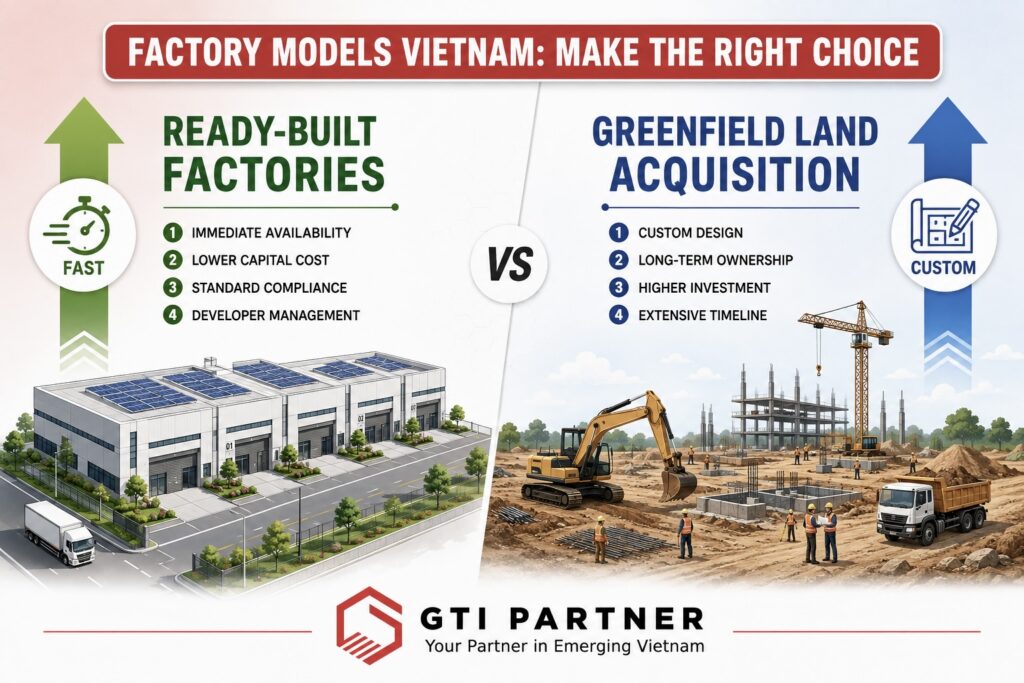
Ready-built factories vs greenfield land acquisition: Choosing the right model in Vietnam
Ready-built factories vs greenfield land acquisition: Choosing the right model in Vietnam When expanding manufacturing
Vietnam’s next generation of industrial parks: What foreign investors need beyond land and infrastructure
Vietnam’s next generation of industrial parks: What foreign investors need beyond land and infrastructure When
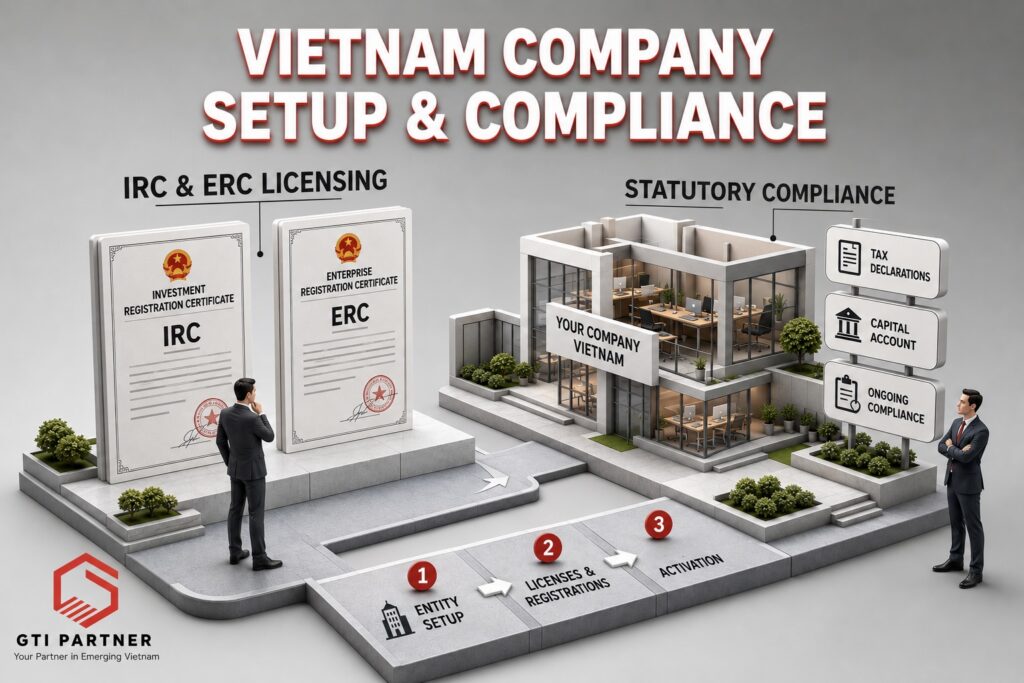
Company registration in Vietnam under the 2026 investment law
Company registration in vietnam under the 2026 investment law Starting a business in Southeast Asia
LLC vs JSC in Vietnam: Which Corporate Structure is Best for Foreign Investors?
LLC vs JSC in Vietnam: Which Corporate Structure is Best for Foreign Investors? Evaluating LLC
Vietnam Market Entry Strategy: 2026 Mistakes to Avoid
Vietnam business entry errors: 2026 Mistakes to Avoid Expanding your business into Southeast Asia requires