
Why Vietnam Market Entry Fails Without a Structured, End-to-End Approach
07/01/2026
Why Vietnam Market Entry Fails Without a Structured, End-to-End Approach
Vietnam remains one of Southeast Asia’s most attractive growth corridors for foreign corporations. Strong GDP metrics, an expanding domestic middle-class demographic, highly competitive labor allocations, and growing trade agreements continue to draw international corporate interest. Yet, despite these clear macroeconomic tailwinds, a vietnam market entry campaign fails far more frequently than most cross-border business planners anticipate.
This drop in commercial traction does not occur because the local business landscape is unsupportive or because local product-market fit cannot be achieved. It occurs primarily because international firms approach expansion tracks as a series of disconnected, ad-hoc administrative tasks rather than a structured execution blueprint.
The Most Critical Vietnam Market Entry Mistake: Fragmented Operations
The single greatest operational error small and medium enterprises make during expansion is fragmentation. Market research is assigned to one generic analytics house, legal structure configuration is handled by an isolated firm, while sales channel establishment, corporate tax compliance, and payroll routing are managed separately and reactively.
This disjointed tracking methodology creates deep execution gaps. Those gaps quickly convert into multi-month administrative delays, hidden compliance penalties, budget overruns, and fractured corporate momentum. A successful vietnam market entry is not an arbitrary corporate checklist; it is an integrated, highly dependent operational sequence. When that execution sequence breaks, your entire commercial launch suffers.
Advisory Insight Alone Cannot Fuel Local Success
Another frequent vulnerability is over-reliance on advisory-only services. Many expanding enterprises receive extensive, generalized strategy manuals and presentation decks, but lack local, hands-on implementation support on the ground. What follows is internal operational confusion, stalled board decisions, and local teams who are fundamentally unsure how to translate theoretical strategy into daily commercial operations.
Navigating the local ecosystem successfully requires far more than passive high-level guidance. It demands dedicated local execution capability, practical provincial coordination, and disciplined, on-the-ground project management through every single phase of development.
The Modular End-to-End Solutions Matrix
To prevent execution failures, GTI Partner builds your corporate footprint through three distinct, outcome-driven operational packages designed to map out your exact stage of development:
| Operational Package | Ideal Target Focus | Core Execution Outcomes |
|---|---|---|
| Market Entry Starter Pack | Firms seeking to rigorously validate and risk-screen local commercial viability before allocating major capital pools. | Real-world feasibility metrics, localized competitor positioning maps, and regulatory barrier identification. Clarity over theory. |
| Business Setup & Compliance Pack | Firms moving directly from investment validation into formal corporate deployment and legal commercial presence. | Fast-tracked corporate entity configuration, operational licensing procurement, structural compliance setups, and local tax mapping. |
| Operational & Scaling Readiness Pack | Entities already established locally that need to optimize infrastructure, align networks, or accelerate distribution growth. | Turnkey workspace organization, local vendor audit pathways, commercial team recruitment compliance, and scalable partner onboarding. |
Why a Structured Strategy Outperforms Ad-Hoc Expansion Tracks
International organizations that achieve scalable success do not rely on isolated service vendors or reactive choices. They lean on execution partners who manage the entire lifecycle of corporate localization. Implementing a structured vietnam market entry framework ensures consistent risk reduction, predictable capital control, compressed setup timelines, and superior long-term commercial yields. It replaces operational guesswork with institutional momentum.
Deploy Your Global Footprint with Absolute Confidence
The local economy delivers remarkable commercial advantages, but only to enterprises that deploy with deep structural clarity and dedicated local execution capabilities on the ground. Recognizing your organization’s precise phase within the lifecycle matrix represents the vital first step toward structural success.

Related posts
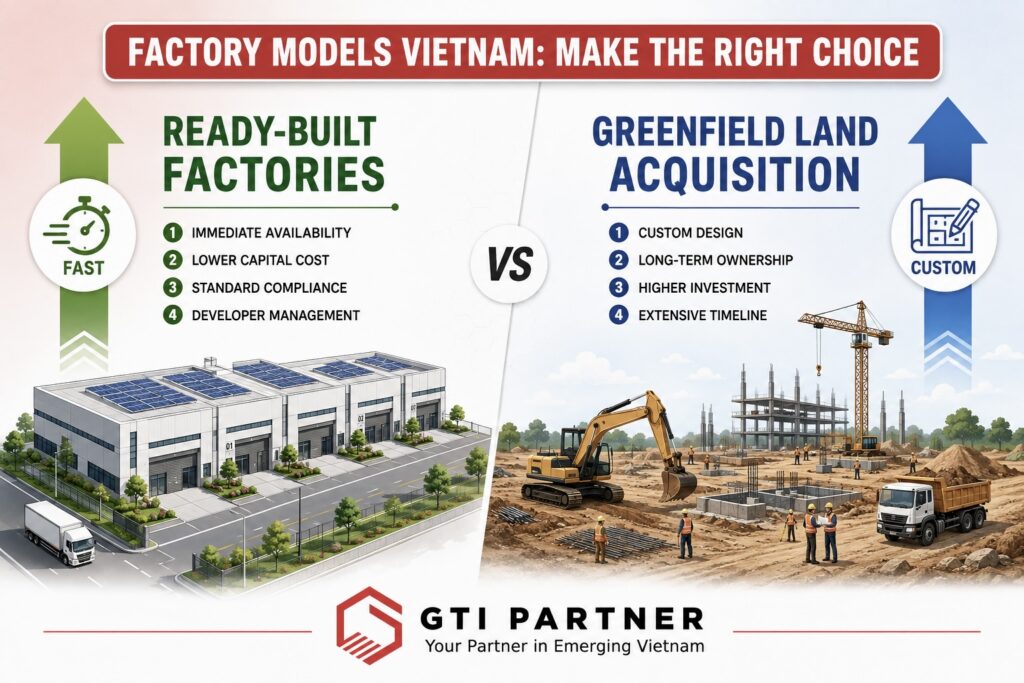
Ready-built factories vs greenfield land acquisition: Choosing the right model in Vietnam
Ready-built factories vs greenfield land acquisition: Choosing the right model in Vietnam When expanding manufacturing

Vietnam’s next generation of industrial parks: What foreign investors need beyond land and infrastructure
Vietnam’s next generation of industrial parks: What foreign investors need beyond land and infrastructure When
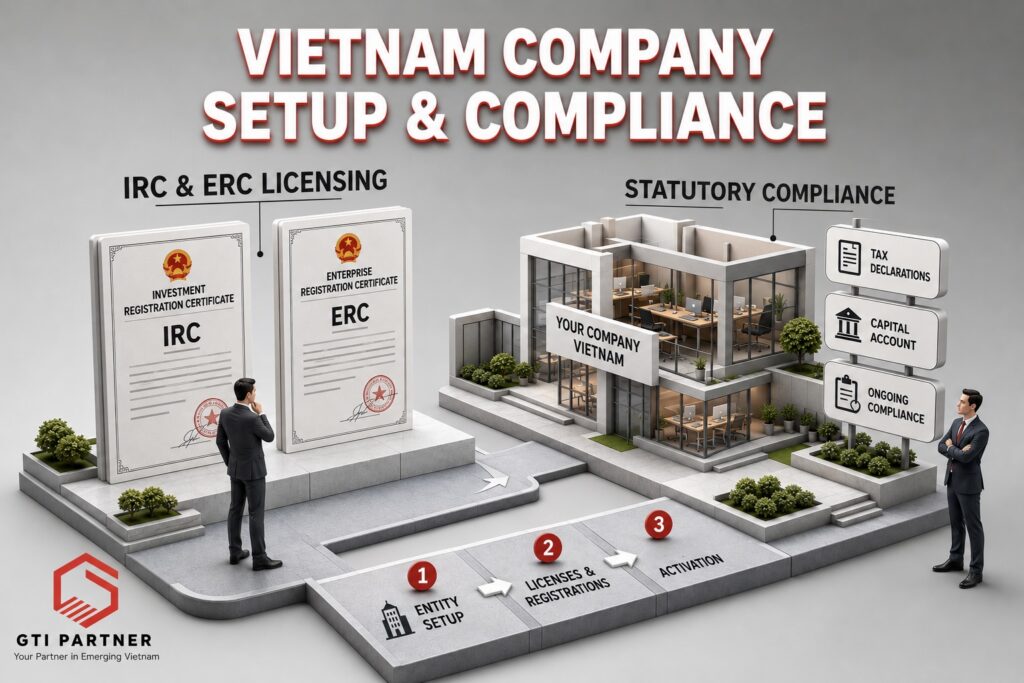
Company registration in Vietnam under the 2026 investment law
Company registration in vietnam under the 2026 investment law Starting a business in Southeast Asia
LLC vs JSC in Vietnam: Which Corporate Structure is Best for Foreign Investors?
LLC vs JSC in Vietnam: Which Corporate Structure is Best for Foreign Investors? Evaluating LLC

Vietnam Market Entry Strategy: 2026 Mistakes to Avoid
Vietnam business entry errors: 2026 Mistakes to Avoid Expanding your business into Southeast Asia requires