
Vietnam Market Entry 2025–2030: Opportunities, Challenges, and Strategies for Global SMEs
26/08/2025
Why Vietnam Remains a Top Destination for SMEs
Developing a structured vietnam market entry guide is becoming essential for international corporations seeking sustainable commercial growth in Southeast Asia. For global small and medium enterprises exploring expansion tracks, this guide breaks down technical strategies, cost allocations, operational risks, and market opportunities within one of Asia’s fastest-growing economies.
With GDP growth projected between 5.5% and 6.5% annually through 2030, continued deep integration into global free trade agreements, and a massive, youthful workforce, Vietnam is no longer just a low-cost manufacturing hub. It is evolving rapidly into a premier destination for consumption, tech innovation, and capital investment.
In the current global economy, small and medium enterprises face constant pressure to diversify supply chains, tap fresh consumer bases, and hedge structural geopolitical risks. Vietnam, strategically situated at the crossroads of Southeast Asia, offers exactly that layout. From production relocation to digital transformation, the coming years represent a prime window for international companies to deploy a resilient market footprint.
How Foreign SMEs Target the Vietnamese Market
International firms typically select one of five foundational corporate structures to enter the local market:
- Commercial agreements with a localized distributor or agent
- Establishment of a Representative Office (RO)
- Strategic Joint Venture (JV) with a domestic partner
- Wholly Foreign-Owned Enterprise (WFOE) structure
- Strategic acquisition of an established domestic entity
Each operational model offers distinct variations regarding administrative control, capital requirements, setup timelines, and compliance liabilities.
Step-by-Step Market Entry Roadmap
- Comprehensive market research and commercial feasibility analysis
- Corporate entry structure selection and tax planning
- Partner identification, commercial matching, and background due diligence
- Official entity business registration, licensing, and permit procurement
- Operational market launch and systematic business development execution
Costs, Timeline, and Deployment Strategy
A reliable vietnam market entry guide must weigh immediate investment values against standard regulatory timelines. Most organizations can plan for a launch timeline spanning 3 to 6 months from preliminary local research to full corporate deployment. Success depends heavily on balancing initial capital allocation with your long-term regional objectives.
Estimated Cost Profiles by Corporate Model
| Corporate Entry Structure | Typical Initial Investment Capital |
|---|---|
| Distributor or Agent Partnership | $5,000 – $20,000 |
| Representative Office (RO) | $10,000 – $30,000 |
| Service Company Formation | $20,000 – $60,000 |
| Industrial Manufacturing Setup | $150,000+ |
Vietnam’s Business Landscape Analysis
Macroeconomic Outlook
Vietnam’s economic infrastructure continues to showcase structural resilience. According to the World Bank, the nation remains a leading growth engine in Southeast Asia, maintaining steady GDP growth above 5%. Financial institutions like the IMF project highly stable expansion patterns moving forward.
- GDP Growth Metrics: Sustained at 5.5% to 6.5% annually through the decade.
- Inflation Controls: Stable at 3% to 4%, providing excellent cost predictability for corporate forecasting.
- Middle-Class Expansion: Projected to encompass 50% of the total population by 2030, driving demand for premium products and consumer services.
Trade Integration and Free Trade Frameworks
Vietnam operates as one of the most open, trade-friendly economies in the Asia-Pacific region, holding active membership in major global frameworks:
- CPTPP (Comprehensive and Progressive Agreement for Trans-Pacific Partnership)
- EVFTA (EU–Vietnam Free Trade Agreement)
- RCEP (Regional Comprehensive Economic Partnership)
- CEPA (Vietnam-UAE Comprehensive Economic Partnership Agreement)
These treaties grant foreign small and medium enterprises aggressive tariff reductions, robust intellectual property rights protection, and preferential market access to billions of consumers worldwide.
Government Incentives and Special Economic Zones
The Ministry of Planning and Investment prioritizes Foreign Direct Investment (FDI) within high-tech manufacturing, green energy infrastructure, specialized logistics networks, and information technology. Entities expanding into designated industrial parks or Special Economic Zones (SEZs) secure corporate tax holidays, lowered land-use fees, and fast-track administrative licensing tracks.
High-Growth Sectors for Foreign Investors
Manufacturing, Production, and Supply Chain Relocation
The global “China+1” diversification model continues to funnel massive industrial investment into Vietnam. Major multinational conglomerates across consumer electronics, semiconductor assembly, apparel, and automotive parts components have established extensive footprints, allowing small and medium enterprises to integrate directly into active supplier ecosystems.
- Electronics and Semiconductors: Core clusters situated across Northern hubs (Hanoi, Bac Ninh, Hai Phong).
- Textiles and Apparel Assembly: Southern commercial zones remain prime choices for scalable production.
- Automotive Component Supply: Suppliers are rapidly scaling across Central industrial corridors to address regional demands.
Technology, Software Development, and IT Outsourcing
With an engineering workforce exceeding 400,000 professionals and local universities producing over 50,000 IT graduates annually, the nation has evolved into a premier tech outsourcing hub. International corporations are shifting away from third-party vendor relationships to establish dedicated, wholly owned development teams on the ground.
Consumer Markets, Retail, and Premium Services
A doubling middle-class demographic creates clear market opportunities across high-value sectors:
- FMCG Sectors: Premium foods, functional beverages, and international household goods.
- E-Commerce and Retail Tech: Operating as one of the fastest-growing digital retail segments in Southeast Asia.
- Healthcare and Medical Logistics: Escalating demand driven by rising disposable incomes and aging demographics.
- Educational Networks: Strong investments in international schools, language academies, and corporate vocational training.
Core Operational Challenges to Anticipate
- Regulatory Complexity: Licensing protocols, customs clearances, and localized compliance rules require meticulous administrative oversight. Inconsistent legal interpretations across provinces can cause logistical delays without localized intervention.
- Talent Management: While junior operational labor is abundant, finding executive-level senior managers and technical compliance specialists requires highly strategic recruitment paths.
- Strategic Partnerships: Rushing distributor selections without intensive corporate due diligence frequently triggers broken contracts. Clear alignment and localized legal frameworks protect early-stage operations.
Standard Corporate Timeline Roadmap
- Market Feasibility and Structural Research: 2 – 4 Weeks
- Corporate Entity Registration and Licensing: 6 – 10 Weeks
- Local Infrastructure and Operational Setup: 2 – 3 Months
- Full Commercial Market Launch: 3 – 6 Months
Winning Execution Strategies for International Expansion
Working with professional consulting groups dramatically mitigates market entry risks. Deploying a premier vietnam market entry guide approach relies on three key pillars:
1. Build Clear Local Representation
Maintaining an on-the-ground presence accelerates localized business matching, streamlines relationships with regional authorities, and ensures smoother commercial contract negotiations.
2. Maintain Strict Accounting and Compliance Readiness
Local corporate reporting mandates compliance with Vietnamese Accounting Standards (VAS), which diverge notably from standard IFRS frameworks. Setting up precise bookkeeping, local payroll networks, and monthly tax filings avoids regulatory fines.
3. Maximize Regional Free Trade Incentives
Aligning your initial corporate footprint with priority sectors or active industrial zones grants access to lucrative long-term tax structures and customs exemptions.
SME Regional Investment Matrix: ASEAN Context
| Investment Factor | Vietnam | Thailand | Indonesia |
|---|---|---|---|
| Operational Labor Cost | Competitive / Low | Moderate | Moderate |
| Domestic Market Scale | Moderate / High Growth | Moderate | Substantial |
| FDI Accessibility & Openness | High Priority | Moderate | Moderate |
Practical Tools and Expansion Resources
To help guide your expansion tracks, access our full tactical suites built specifically for growing businesses:
📌 Vietnam Market Entry Checklist – A step-by-step operational roadmap.
📌 5 Key Expansion Mistakes to Avoid – Critical missteps to bypass during launch phases.
📌 Vietnam FDI Handbook – Expert insights on laws, tax structures, and priority industrial sectors.
Conclusion
Vietnam stands out as a highly dynamic, strategic target for small and medium enterprise development. Its robust macroeconomic foundations, rising localized purchasing power, and key global trade integrations present a rare path to commercial growth. However, long-term profitability requires a tailored vietnam market entry guide strategy, careful structural engineering, and reliable local execution support.
GTI Partner assists global organizations in building and executing bulletproof expansion campaigns—from initial feasibility screening to corporate entity formation and full market launch execution.
Related posts

Vietnam IT Outsourcing: How AI is Transforming the Industry
Vietnam IT Outsourcing: How AI is Transforming the Industry The landscape of Vietnam IT outsourcing

Vietnam Industrial Parks 2026: The Strategic FDI Playbook
Insights from the IMC 2026 keynote panel on navigating site selection, technical commissioning, and ESG
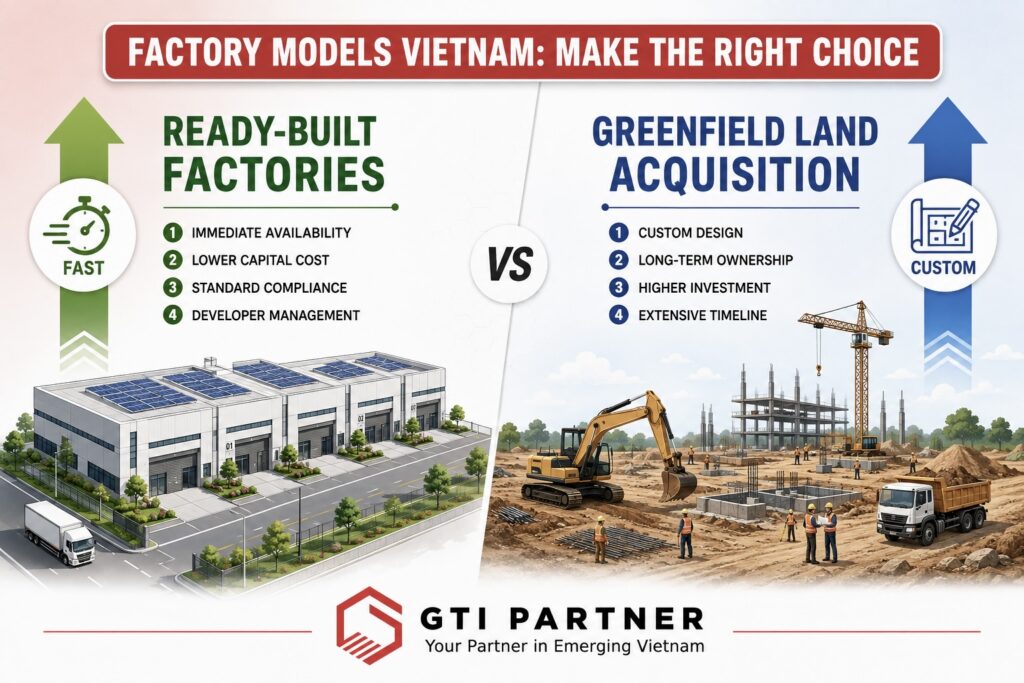
Ready-built factories vs greenfield land acquisition: Choosing the right model in Vietnam
Ready-built factories vs greenfield land acquisition: Choosing the right model in Vietnam When expanding manufacturing

Vietnam’s next generation of industrial parks: What foreign investors need beyond land and infrastructure
Vietnam’s next generation of industrial parks: What foreign investors need beyond land and infrastructure When
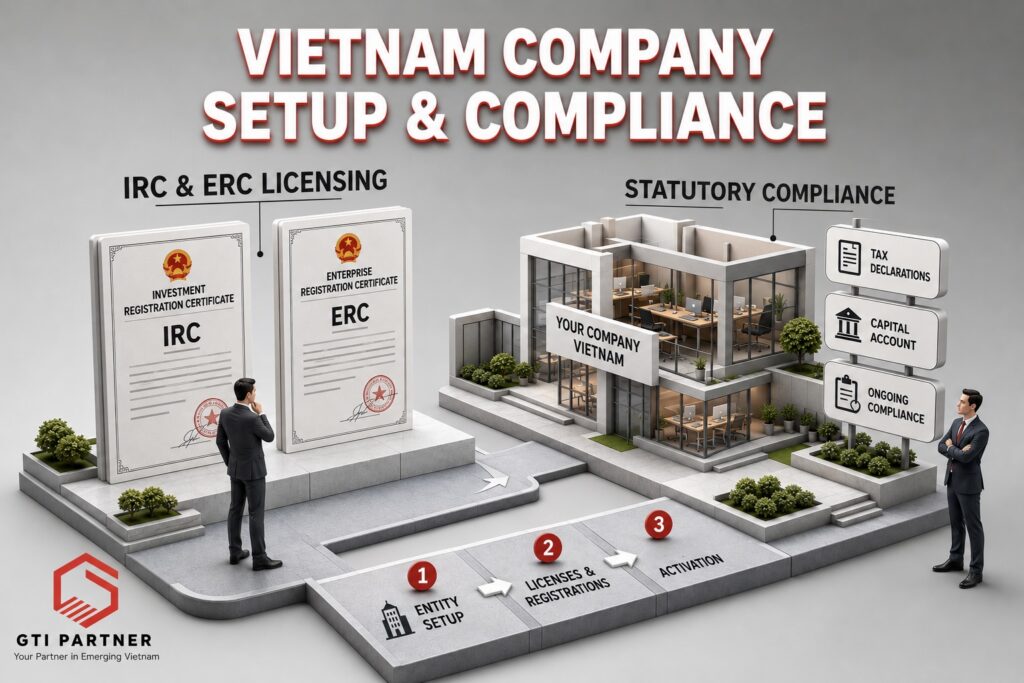
Company registration in Vietnam under the 2026 investment law
Company registration in vietnam under the 2026 investment law Starting a business in Southeast Asia