
Cost of Setting Up a Company in Vietnam
03/03/2026
2026 Guide for ASEAN-Focused Foreign SMEs
The cost of setting up a company in Vietnam is one of the most important considerations for ASEAN-focused SMEs evaluating regional expansion in 2026. Vietnam is strategically positioned within ASEAN as a growth market for manufacturing, services, and regional supply chains. But before deciding to expand, ASEAN-focused companies must understand the true cost of setting up a company—not just the headline fees, but the economic, regulatory, and operational costs tied to long-term success.
This guide breaks down:
- What costs you will face
- Where expenses cluster (and where surprises appear)
- How to plan capital before execution
- What local insights matter from an ASEAN perspective
1. Government Fees in the Cost of Setting Up a Company in Vietnam
The first layer of cost in Vietnam is statutory fees. What to expect:
- Company registration and business license fees
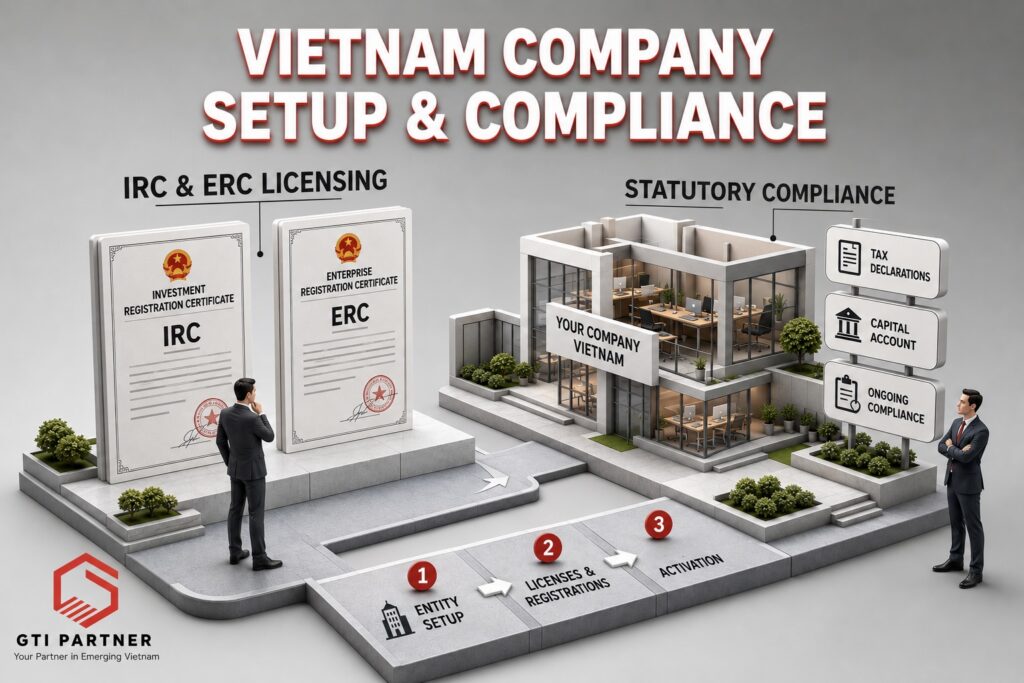
- Investment Registration Certificate (IRC) fee for foreign ownership structures
- Industry-specific operating permits (e.g., food, cosmetics, logistics)
These are relatively predictable, but they are only the beginning. Review our deeper regulatory insights on Vietnam regulatory risk and compliance for foreign investors to help your team understand timing and sequencing beyond the basic cost.
Vietnam Market Entry Readiness Guide
2. Legal and Advisory Costs of Setting Up a Company in Vietnam (Strategic vs. Procedural)
ASEAN-based SMEs commonly underestimate the legal and advisory budget. This is not just about basic incorporation support; it is about structuring an entity that aligns with your long-term operational realities.
Typical costs include:
- Legal entity structuring and validation
- Drafting investment proposals for regulatory review
- Negotiating favorable charter capital minimums
- Local compliance advisory (tax, labor, and corporate governance)
Although many local firms quote low filing fees, the strategic value comes from understanding nuances like nominee risk, transfer pricing exposure, and initial capital planning.
Reviewing common market entry mistakes helps foreign investors avoid costly regulatory missteps during establishment.
Vietnam Market Entry Packages: A Practical Approach for SMEs
3. Charter Capital and Banking Setup Costs
Vietnam mandates certain capital injections depending on your business line and sector. For ASEAN firms evaluating cost comparisons across the region, two points stand out:
- Vietnam’s capital injection timing can affect banking and operational readiness. You must contribute your full charter capital within 90 days of registration.
- ASEAN neighbors like Thailand and Singapore have completely different capital regimes, which means regional cost calculations are not apples-to-apples.
You must prepare realistic capital injections and banking coordination costs because this directly affects your early cash flow.
See Vietnam vs. Indonesia
See Vietnam vs. Thailand
4. Office, Lease & Operational Setup Costs
Once legal structures and capital are sorted, operational setup costs begin:
- Office lease deposits or industrial park rent parameters
- Utility setups, IT architecture, and mandatory digital signatures
- Local management recruitment and early payroll allocations
- Technology infrastructure and ongoing professional services
These costs vary widely between cities (HCMC vs. Hanoi vs. Da Nang) and across sectors (services vs. manufacturing). ASEAN companies should weigh these setup costs against alternative hubs like Bangkok or Jakarta, taking into account localized labor rates and logistics synergies.
5. Ongoing Compliance After Setting Up a Company in Vietnam
The headline entry cost misses the ongoing maintenance budget. Fixed structural obligations include:
- Statutory accounting setups and mandatory annual audits
- Monthly VAT, corporate income tax (CIT), and payroll tax filings
- Annual reporting submissions to investment bureaus
- Local labor compliance and social insurance management
Often heavier than initial startup costs, these ongoing expenses require disciplined planning. For ASEAN firms with multi-country exposure, local compliance costs in Vietnam vary significantly from Singapore or Malaysia.
How to Set Up a Business in Vietnam
6. Hidden Costs Foreign SMEs Often Overlook
The soft costs are where many ASEAN companies miscalculate entry tracks:
- Delays due to incorrect procedural sequencing between the IRC and ERC
- Permit renewals and conditional licensing adjustments
- Official translation and consular document legalization fees
- Travel and coordination costs for cross-border management teams
Cost planning requires quantifying these variables early, rather than assuming they are trivial.
7. Capital Planning Reality Check
Putting an accurate number on the total cost means modeling around these specific expenditure buckets:
| Cost Category | Typical Range (Illustrative) |
|---|---|
| Government & Registration | Low |
| Legal & Advisory | Medium |
| Capital Injection | Medium to High (Sector Dependent) |
| Operational Setup | Medium |
| Annual Compliance | Medium |
| Soft / Delay Costs | Variable |
ASEAN-focused firms should budget conservatively, especially if they are using Vietnam as a regional hub. Capital assumptions here should be stress-tested against market volatility and regulatory changes.
As you plan your market entry and setup expenses, maximizing business visibility in regional networks is critical. Discover partnership and participation details at the International Manufacturing Congress 2026.
8. Strategic Conclusion + Next Step
Vietnam’s cost structure remains highly competitive within ASEAN. However, it is not friction-free. Its real economic advantage shows up when planning for long-term scalability, local compliance foundations, and establishing a capital runway for 18 to 24 months.
Understanding the full cost of setting up a company in Vietnam allows ASEAN businesses to make informed capital allocation decisions before market entry. If your company is serious about ASEAN expansion and needs to quantify feasibility before capital commitment, the next step is a Strategic Feasibility Assessment with GTI Partner.
For official company registration procedures and statutory fees, refer to the National Business Registration Portal.
Frequently Asked Questions
What is the minimum capital requirement to set up a company in Vietnam?
Vietnam law does not specify a global minimum capital requirement for most sectors, but the capital must be sufficient to cover business operations until profitable. Most foreign SMEs start with 10,000 USD to 50,000 USD depending on the industry.
What are the main costs involved in Vietnam business setup?
Main costs include government licensing fees, legal advisory, registered office address rental, initial capital injection, and translation or notarization fees.
Related posts

Vietnam’s next generation of industrial parks: What foreign investors need beyond land and infrastructure
Vietnam’s next generation of industrial parks: What foreign investors need beyond land and infrastructure When
Company registration in Vietnam under the 2026 investment law
Company registration in vietnam under the 2026 investment law Starting a business in Southeast Asia
LLC vs JSC in Vietnam: Which Corporate Structure is Best for Foreign Investors?
LLC vs JSC in Vietnam: Which Corporate Structure is Best for Foreign Investors? Evaluating LLC
Vietnam Market Entry Strategy: 2026 Mistakes to Avoid
Vietnam business entry errors: 2026 Mistakes to Avoid Expanding your business into Southeast Asia requires