
Company Registration in Vietnam: Step-by-Step Guide for Foreign SMEs (2026)
17/02/2026
Company Registration in Vietnam: Step-by-Step Guide for Foreign SMEs (2026)
Vietnam continues to attract foreign SMEs seeking rapid growth in Southeast Asia. But for many businesses, the first major barrier is understanding how corporate company registration actually works in practice.
Too often, businesses treat registration as a back-office administrative task. In reality, it dictates your operational capacity, tax liabilities, and corporate governance flexibility. This guide breaks down the company registration process in Vietnam step by step, helping foreign decision-makers move smoothly from baseline research to secure local execution.
Who Can Register a Company in Vietnam?
Foreign individuals and corporate entities can register a business in Vietnam, depending heavily on sector eligibility and global ownership rules.
In many standard industrial, manufacturing, and technology sectors, foreign SMEs are allowed 100% full ownership. However, conditional sectors (such as logistics, trading, or specialized education) may require additional regulatory approvals, minimum capital structures, or local joint-venture partnerships. Because compliance requirements vary wildly by business line, selecting your corporate structure correctly from day one is essential to avoid forced operational pauses.
Businesses planning structured expansion should evaluate their options early by reviewing our comprehensive guide on Company Setup in Vietnam alongside a broader operational market strategy.
The 5 Stages of the Vietnam Company Registration Process
While industry-specific details vary, establishing a compliant entity in Vietnam requires executing five highly synchronized phases:
1. Choosing Your Legal Business Structure
Foreign investors must select the exact vehicle that matches their commercial timeline:
• Wholly Foreign-Owned Enterprise (WFOE): Ideal for full operational control and manufacturing projects.
• Joint Venture (JV): Required for conditional sectors needing a local minority partner.
• Representative Office: Best for rapid, non-revenue market validation and product liaison functions. (Learn more about setting up a representative office in vietnam).
2. Securing the Investment Registration Certificate (IRC)
For most foreign-owned setups, the first formal legal gate is securing the IRC from the Department of Planning and Investment (DPI). This certificate outlines your specific investment project scope, designated charter capital structure, and authorized business sub-activities. Clear capitalization plans move through this phase significantly faster.
3. Obtaining the Enterprise Registration Certificate (ERC)
Once the IRC is approved, the legal company entity itself is established via the ERC. This yields your official corporate tax code, unlocks corporate seal creation, and allows formal operational site preparations to begin on the ground.
Comprehensive Master Guide Available
Looking for detailed steps on legal incorporation and regulatory adherence? Read our complete manual on Vietnam Company Setup and Compliance to navigate IRC, ERC, and statutory requirements effectively.
4. Licensing and Conditional Sub-Permits
Acquiring an ERC does not automatically mean you can trade. Conditional industries (like E-commerce, distribution retail, or physical manufacturing) require post-ERC sub-licenses, environmental impact audits, or fire safety approvals before commercial operations can legally launch.
5. Mandatory Post-Incorporation Tax Setup
The final critical milestone requires setting up your specialized capital bank account, executing initial charter capital injections within strict statutory windows, naming a Chief Accountant, and building a compliant electronic invoicing structure. You can review our operational Vietnam Post-Incorporation Compliance Guide to protect your corporate standing from immediate tax penalties.
For a broader view on how these compliance shifts fit into your total entry strategy, see our recent breakdown on the 3 Hidden Vietnam Market Entry Bottlenecks.
Typical Registration Timelines and Common Delay Traps
A standard company registration sequence in Vietnam usually spans 4 to 8 weeks for non-conditional sectors. For regulated spaces or complex operational structures, this timeline can stretch significantly longer.
The most frequent sources of delays include poorly translated legal documents, mismatched business lines within the charter, and incorrect capital contribution declarations. Approaching the expansion using clear, fixed vietnam market entry packages allows foreign corporate teams to sidestep these administrative bottlenecks entirely via predefined milestone schedules.
Common Mistakes Foreign SMEs Make during Entity Registration
- Premature Entity Selection: Locking into a legal structure before fully defining your on-the-ground sales, logistics, and physical execution strategy.
- Ignoring Sub-Permit Triggers: Believing the ERC is the final step, only to face regulatory shutdowns for lack of specialized retail or trading sub-licenses.
- Weak Financial Planning: Failing to structure charter capital injections within the mandatory local statutory timelines.
- Choosing Cost Over Scalability: Partnering with generic document-filing agencies that do not align local entity frameworks with your global corporate governance needs.
How GTI Partner Executes Company Registration Differently
GTI Partner completely replaces passive document filing with proactive, execution-focused market entry structures. We combine local legal setup with real-world infrastructure deployment to ensure your enterprise is fully operational from day one.
Our core framework handles:
- Bespoke structural entity scoping and corporate planning
- Complete local regulatory coordination and rapid permit acquisition
- Operational launch readiness (Bank setup, accounting systems, local contracts)
- Permanent corporate compliance and cross-border governance oversight
Ready to Safely Register Your Company in Vietnam?
Frequently Asked Questions
Can foreigners register a company in Vietnam?
Yes. Foreign individuals and multinational corporations can establish businesses with up to 100% equity ownership across a vast array of open commercial sectors, subject to specific licensing protocols and sub-activity scoping rules.
How long does company registration in Vietnam take?
For standard business profiles, the complete corporate registration cycle takes between 4 to 8 weeks. Regulated sectors requiring auxiliary ministerial reviews will extend this timeline.
Do foreign SMEs always need an Investment Registration Certificate (IRC)?
Yes, an IRC is a mandatory legal prerequisite for any newly formed entity where a foreign individual or corporation holds direct equity stake. It must be issued before the ERC application can begin.
What is the difference between company registration and a representative office?
A registered local company is a full legal entity allowed to execute commercial transactions, sign local manufacturing agreements, and generate revenue. A representative office is strictly a non-revenue cost center restricted to basic marketing research and parental business liaison duties.
What is the biggest mistake foreign SMEs make during company setup?
Treating the corporate setup as isolated administrative paperwork. Failing to align the legal registration parameters with local operational logistics regularly triggers costly, drawn-out corporate restructuring phases down the line.
Related posts

Vietnam’s next generation of industrial parks: What foreign investors need beyond land and infrastructure
Vietnam’s next generation of industrial parks: What foreign investors need beyond land and infrastructure When
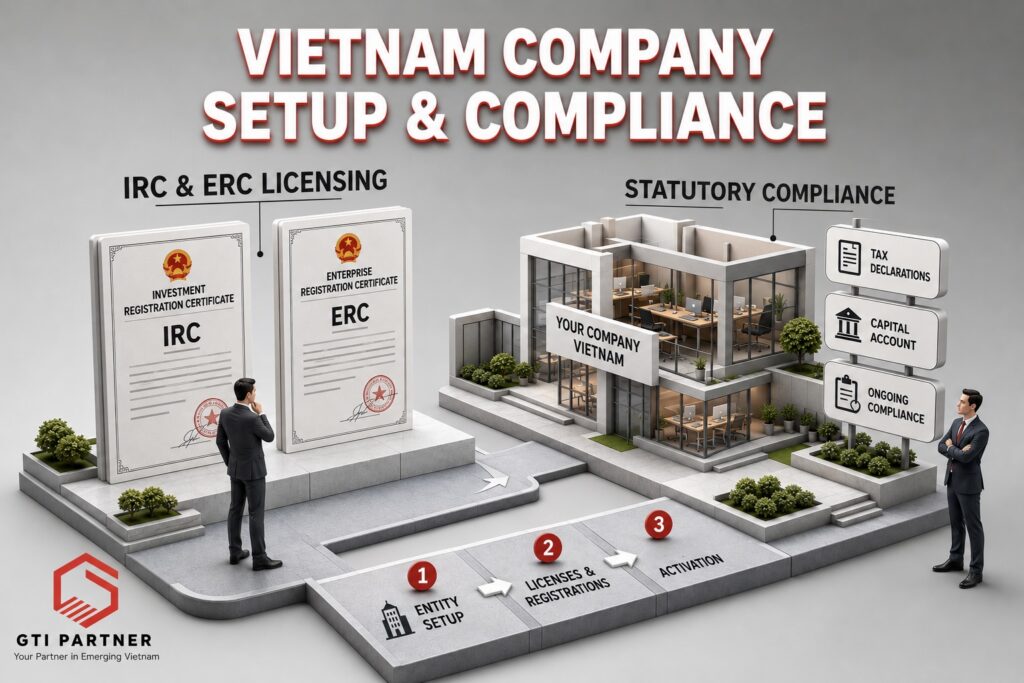
Company registration in Vietnam under the 2026 investment law
Company registration in vietnam under the 2026 investment law Starting a business in Southeast Asia
LLC vs JSC in Vietnam: Which Corporate Structure is Best for Foreign Investors?
LLC vs JSC in Vietnam: Which Corporate Structure is Best for Foreign Investors? Evaluating LLC

Vietnam Market Entry Strategy: 2026 Mistakes to Avoid
Vietnam business entry errors: 2026 Mistakes to Avoid Expanding your business into Southeast Asia requires