
Vietnam CIT 2026 for Foreign SMEs: Navigating the New Tax Landscape
06/04/2026
Vietnam CIT 2026 for Foreign SMEs: Navigating the New Tax Landscape
The regulatory environment in Southeast Asia is evolving rapidly, and the recent implementation of the Vietnam CIT 2026 for foreign SMEs represents the most significant shift in a decade. With the Law on Corporate Income Tax (CIT) 2025 and Circular 20/2026/TT-BTC now in full effect, the days of pre-approval leniency have been replaced by a rigorous “post-inspection” (hậu kiểm) model. For international business owners, understanding these changes is no longer optional – it is a prerequisite for survival!
Why Vietnam CIT 2026 for Foreign SMEs is a Game Changer
For years, foreign companies operating in Vietnam relied on a predictable, albeit slow, tax registration process. However, the Vietnam CIT 2026 for foreign SMEs framework has inverted this logic. Under the new post-inspection regime, the government allows for faster initial setup but places the burden of proof entirely on the taxpayer during retrospective audits.
This means that while you can get your business up and running faster than in 2024, the risk of significant penalties during Year 2 or Year 3 of operations has increased. Authorities are now utilizing advanced data matching to cross-reference bank transactions with declared revenues, leaving little room for “informal” accounting practices.
This guide is part of our comprehensive Company Setup in Vietnam Master Hub–your complete roadmap for corporate registration.
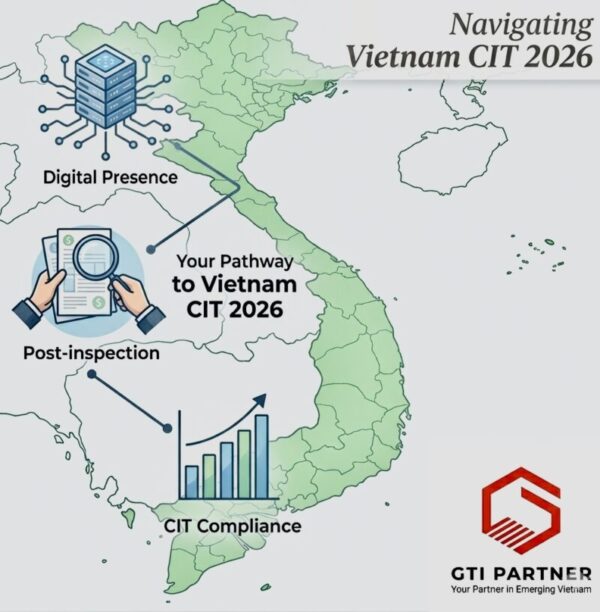
Understanding Digital Presence and Tax Nexus Under Vietnam CIT 2026
One of the most talked-about aspects of the Vietnam CIT 2026 for foreign SMEs is the expansion of the “Permanent Establishment” (PE) definition. In the past, if you didn’t have a physical office, you often flew under the tax radar.
Today, if your business has a significant digital presence, defined by local server usage, Vietnamese language domains, or a specific threshold of local transactions – you are liable for CIT. This is particularly relevant for e-commerce entities and SaaS providers who previously operated from offshore bases like Singapore or Hong Kong.
Key Compliance Requirements in 2026:
- Electronic Invoicing: Mandatory integration with the General Department of Taxation’s real-time portal.
- Substance Requirements: You must prove that management and control are actually exercised within Vietnam to claim treaty benefits.
- Transfer Pricing: Stricter documentation for any cross-border transactions with parent companies.
Market Entry Strategy for Vietnam CIT 2026 Compliance
Choosing between a Representative Office in Vietnam and a full Company Registration is now a tax-heavy decision. While an RO remains exempt from CIT, the 2026 regulations have tightened the definition of “non-commercial” activities. If your RO is found to be facilitating sales, the tax authorities may “deem” a profit and apply the Vietnam CIT 2026 for foreign SMEs rates retrospectively.
For those looking for long-term growth, a Wholly Foreign-Owned Enterprise (WFOE) is often the better route, provided you have a robust Vietnam market entry strategy that accounts for these tax liabilities from Day 1.
Strategies to Optimize Vietnam CIT 2026 for Foreign SMEs
How can your business stay compliant while remaining profitable? It starts with the “Substance First” principle. The 2026 framework rewards companies that invest in local infrastructure and human capital.
- Localize Your Accounting: Gone are the days of managing Vietnamese books from an overseas HQ. You need local experts who understand the nuances of Circular 20/2026/TT-BTC.
- Regular Internal Audits: Since the government is moving to a post-inspection model, you should conduct your own mock audits annually to ensure your digital footprint matches your tax filings.
- Utilize Incentives: Despite the stricter rules, Vietnam still offers generous tax holidays for High-Tech and Green Growth sectors. Ensuring your company registration in Vietnam is filed under the correct business code is essential to unlocking these benefits.
Conclusion: Preparation is the New Compliance
The Vietnam CIT 2026 for foreign SMEs is designed to professionalize the market. While the transition may seem daunting, it actually creates a more level playing field for legitimate international businesses by weeding out non-compliant competitors.
By aligning your cost of setting up a company in Vietnam with a long-term tax strategy, you can turn these regulatory hurdles into a competitive advantage. The era of “wait and see” is over – the era of “comply and conquer” has begun!
Summary Table for 2026 Entry Strategy
| Feature | 2024/2025 Approach | 2026 Approach (Current) |
| Tax Rate (SMEs) | Flat 20% | 15% – 17% (Tiered) |
| Digital Sales | Selective enforcement | Mandatory PE Registration |
| Deduction Limit | 20M VND (Cash) | 5M VND (Cash) |
| Setup Order | IRC → ERC | ERC → IRC (Selected sectors) |
| Audit Style | Pre-approval focus | Post-inspection (Hậu kiểm) |
Related posts

Vietnam IT Outsourcing: How AI is Transforming the Industry
Vietnam IT Outsourcing: How AI is Transforming the Industry The landscape of Vietnam IT outsourcing

Vietnam Industrial Parks 2026: The Strategic FDI Playbook
Insights from the IMC 2026 keynote panel on navigating site selection, technical commissioning, and ESG

Ready-built factories vs greenfield land acquisition: Choosing the right model in Vietnam
Ready-built factories vs greenfield land acquisition: Choosing the right model in Vietnam When expanding manufacturing

Vietnam’s next generation of industrial parks: What foreign investors need beyond land and infrastructure
Vietnam’s next generation of industrial parks: What foreign investors need beyond land and infrastructure When
Company registration in Vietnam under the 2026 investment law
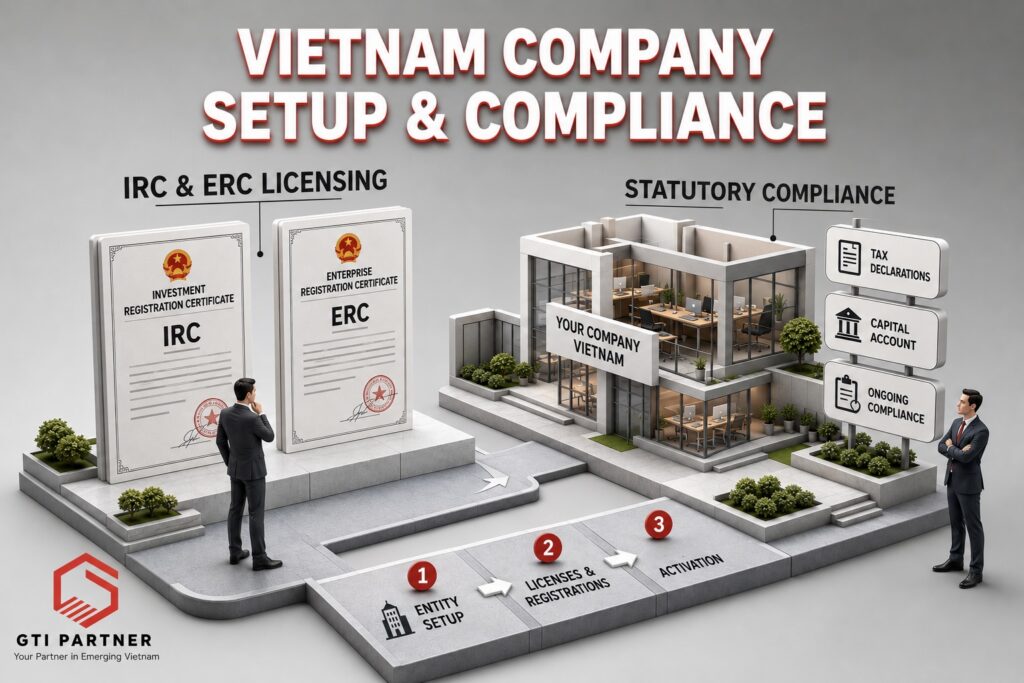
Company registration in vietnam under the 2026 investment law Starting a business in Southeast Asia