
Investment Registration Certificate Vietnam (IRC Guide 2026)
13/02/2026
Investment Registration Certificate Vietnam: 2026 Application Guide
Securing an Investment Registration Certificate Vietnam is the first critical step for any foreign investor looking to enter the local market. By obtaining an Investment Registration Certificate Vietnam, you protect your capital and ensure legal compliance, as outlined by the National Business Registration Portal.
Investment Registration Certificate Vietnam: Quick-Start Checklist (2026)
- ✅ Step 1: Determine if your industry requires an Investment Registration Certificate Vietnam or only an ERC.
- ✅ Step 2: Assemble corporate dossiers (notarized & consularized).
- ✅ Step 3: Secure a compliant commercial office lease.
- ✅ Step 4: File online declaration via the National Foreign Investment Information System.
- ✅ Step 5: Submit physical dossier to provincial DPI.
When planning your initial setup, compliance extends past the registration phase. Foreign investors must review the rules for repatriating corporate profits under an IRC framework to avoid central bank audit blocks. For global SMEs, mapping out this process prevents costly operational delays. This guide explains what the certificate entails, when it is legally mandatory, the step-by-step approval sequence, realistic timeframes, and common rejection reasons.
As a foundational element of your broader Vietnam market entry strategy, foreign investors must accurately determine their target entity structure before filing corporate portfolios with licensing ministries. This guide is part of our comprehensive Company Setup in Vietnam Master Hub.
What Is an Investment Registration Certificate Vietnam?
An Investment Registration Certificate is an official state authorization issued by Vietnam’s Department of Planning and Investment (DPI) or regional Industrial Zone (IZ) management boards. This certificate serves as formal state approval for foreign-invested projects across the country.
It is crucial to understand that the certificate approves the specific investment project parameters, not the corporate entity itself. The Investment Registration Certificate Vietnam establishes the lawful boundaries of your project, including official project identity, foreign investor credentials, capitalization baselines, operational duration, and approved commercial activities.
Under the current Vietnam Investment Law, foreign investors can access a flexible, dual-track licensing framework depending on their industry classification:
- The Traditional Track (IRC-First): Securing project approval via the IRC first, followed immediately by the ERC. This remains the mandatory sequencing for manufacturing plants, heavy industries, and highly regulated conditional sectors.
- The Modern Fast-Track (ERC-First): Select liberalized service, IT, and trading sectors are permitted to obtain their ERC first to establish their legal corporate identity immediately.
IRC = Official state validation of the foreign investment project scale.
ERC = Legal validation and tax activation for company setup in Vietnam.
IRC vs. ERC: Key Differences
| Comparison Item | Investment Registration Certificate (IRC) | Enterprise Registration Certificate (ERC) |
|---|---|---|
| Primary Purpose | Formal project and capital investment approval. | Legal entity registration and company formation. |
| Required For | Foreign investors and majority foreign-owned firms. | All business entities operating inside Vietnam. |
| Issuing Authority | Department of Planning and Investment (DPI) / IZ Board. | Provincial Business Registration Office. |
When Do You Need to Secure an Investment Registration Certificate Vietnam?
A foreign investor must successfully apply for an Investment Registration Certificate Vietnam under the following structural conditions:
- Establishing a brand new, fully foreign-owned business entity.
- Acquiring majority corporate shares or equity control within regulated conditional sectors.
- Expanding or modifying the capital scale of an existing foreign-invested commercial project.
- Locating operations inside specialized industrial zones, export zones, or high-tech economic clusters.
Investment Registration Certificate Vietnam Documentation Requirements

The 2026 IRC & ERC Licensing Roadmap for Foreign Investors in Vietnam.
To secure approval from the DPI, your entry dossier must be meticulously structured. Foreign corporate documents must be notarized and receive full consular legalization in your home jurisdiction. The core portfolio requirements include:
- Legal Identity Documents: Validated passports for individual investors or certified corporate licenses.
- Financial Capacity Proof: Verified corporate bank balance sheets or audited financial accounts.
- Detailed Business Plan: A structured project outline detailing operational objectives and market feasibility.
- Compliant Office Lease: A commercial lease contract that meets strict zoning requirements.
Foreign investors setting up operations can also leverage major trade and manufacturing events. Learn more about upcoming opportunities through the International Manufacturing Congress 2026 Hosted Buyer Programme.
The Step-by-Step IRC Application Sequence
Step 1: Portfolio Compilation and Legalization
Assemble all required identity and banking proofs, ensuring absolute alignment with regional requirements.
Step 2: Formal Submission to Licensing Divisions
File the complete application dossier with the provincial Department of Planning and Investment (DPI) or relevant Industrial Zone Board.
Step 3: Administrative Evaluation and Clarification
In practice, most investment portfolios go through at least one clarification cycle.
Step 4: Formal Certificate Issuance
Upon verification, authorities issue your physical Investment Registration Certificate.
Proper preparation prevents administrative mistakes during setup from halting your operational timeline.
Realistic Timeline Projections
While the official statutory review timeline is set at 15 working days, practical real-world execution tracks show longer windows based on industry sectors:
- Standard Unrestricted Sectors: 20 to 30 working days.
- Conditional or Regulated Sectors: 30 to 45+ working days.
- Complex Global Projects: 45 to 60+ working days.
Common Rejection Pitfalls to Avoid
Submissions are routinely delayed or rejected due to predictable administrative mistakes:
- Vague Business Scope Descriptions: Generic terms trigger immediate clarification halts.
- Inadequate Capital Proofs: Discrepancies between your parent entity bank capacity and project scale.
- Non-Compliant Office Leases: Attempting to use residential addresses without verified land-use certification.
- Improper Document Legalization: Missing precise consular authentication stamp arrays.
Why GTI Partner?
Don’t just register—structure for growth. At GTI Partner, we architect your Investment Registration Certificate Vietnam to ensure your business scope is broad enough to accommodate 2–3 years of planned growth, not just your current setup.
Frequently Asked Questions
Is an Investment Registration Certificate mandatory for all setups?
Yes. An active IRC is a mandatory legal prerequisite for any new corporate entity setup containing foreign direct investment.
Can international firms apply for an IRC without local partners?
Yes. 100% foreign equity structures are fully permitted in most standard commercial categories.
Strategic Corporate Field Execution
GTI Partner delivers hands-on consulting to guide global SMEs seamlessly through the complete licensing pipeline.
Contact GTI Partner to Secure Your IRC
Frequently Asked Questions
How long does it take to get an Investment Registration Certificate in Vietnam?
The statutory processing time for an Investment Registration Certificate (IRC) is typically 15 working days from submitting a complete application, though preparation and review may take 3 to 4 weeks.
What authority issues the IRC in Vietnam?
The Department of Planning and Investment (DPI) or the local Industrial Zone Management Board issues the Investment Registration Certificate depending on the project location.
Related posts
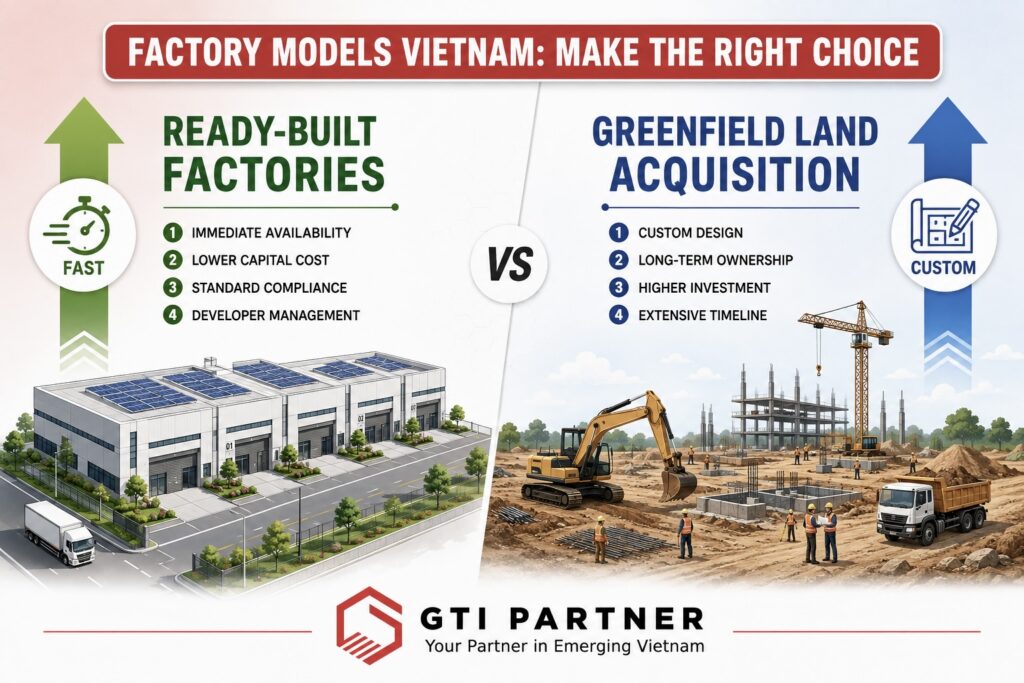
Ready-built factories vs greenfield land acquisition: Choosing the right model in Vietnam
Ready-built factories vs greenfield land acquisition: Choosing the right model in Vietnam When expanding manufacturing

Vietnam’s next generation of industrial parks: What foreign investors need beyond land and infrastructure
Vietnam’s next generation of industrial parks: What foreign investors need beyond land and infrastructure When
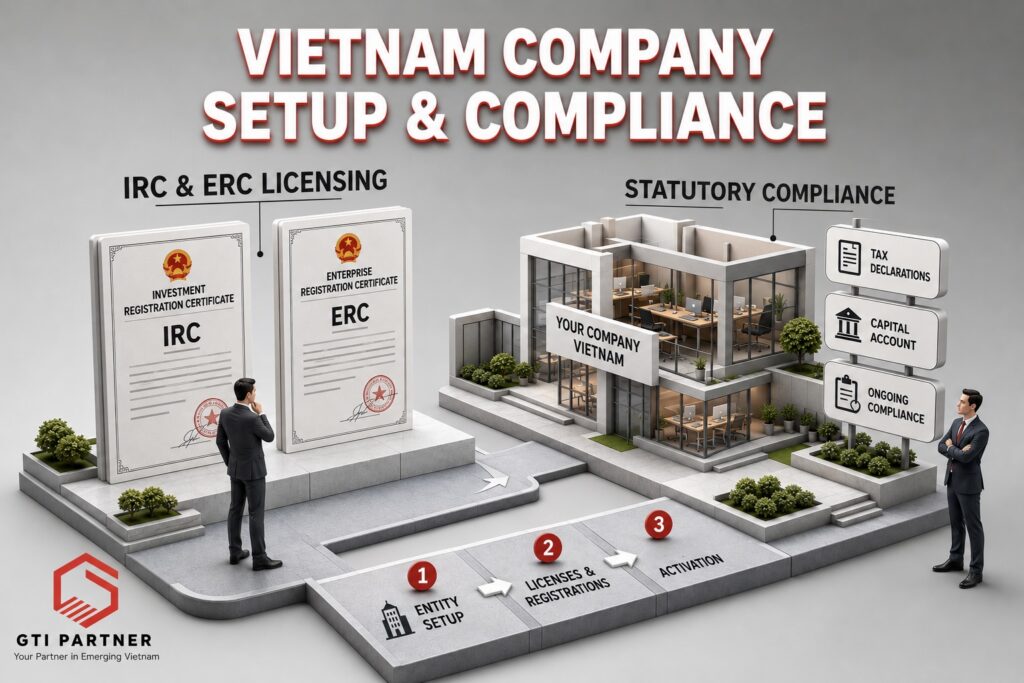
Company registration in Vietnam under the 2026 investment law
Company registration in vietnam under the 2026 investment law Starting a business in Southeast Asia
LLC vs JSC in Vietnam: Which Corporate Structure is Best for Foreign Investors?
LLC vs JSC in Vietnam: Which Corporate Structure is Best for Foreign Investors? Evaluating LLC
Vietnam Market Entry Strategy: 2026 Mistakes to Avoid
Vietnam business entry errors: 2026 Mistakes to Avoid Expanding your business into Southeast Asia requires