
Foreign Investment in Vietnam Just Got Easier: What the 2026 Investment Law Changes
09/03/2026
Foreign Investment in Vietnam Just Got Easier: What the 2026 Investment Law Changes
Vietnam’s Investment Law 2026 introduces several reforms that simplify market entry for foreign investors. The new legal framework reduces administrative barriers and signals Vietnam’s intent to attract higher-quality international investment. Vietnam has spent the past decade positioning itself as one of Asia’s most attractive destinations for foreign investment, and the country is taking another major step forward.
On March 1, 2026, Vietnam’s new Law on Investment officially entered into force, introducing structural reforms designed to simplify market entry, reduce administrative friction, and make the regulatory framework more predictable for international companies.
For foreign investors evaluating Vietnam as a regional base, these changes matter. They signal a clear policy direction: fewer procedural barriers and faster company establishment.
Below are the key changes and what they mean in practice.
Vietnam Investment Law 2026: A Major Shift in Company Establishment
One of the most significant reforms under the new law is the change to the licensing sequence for foreign investors.
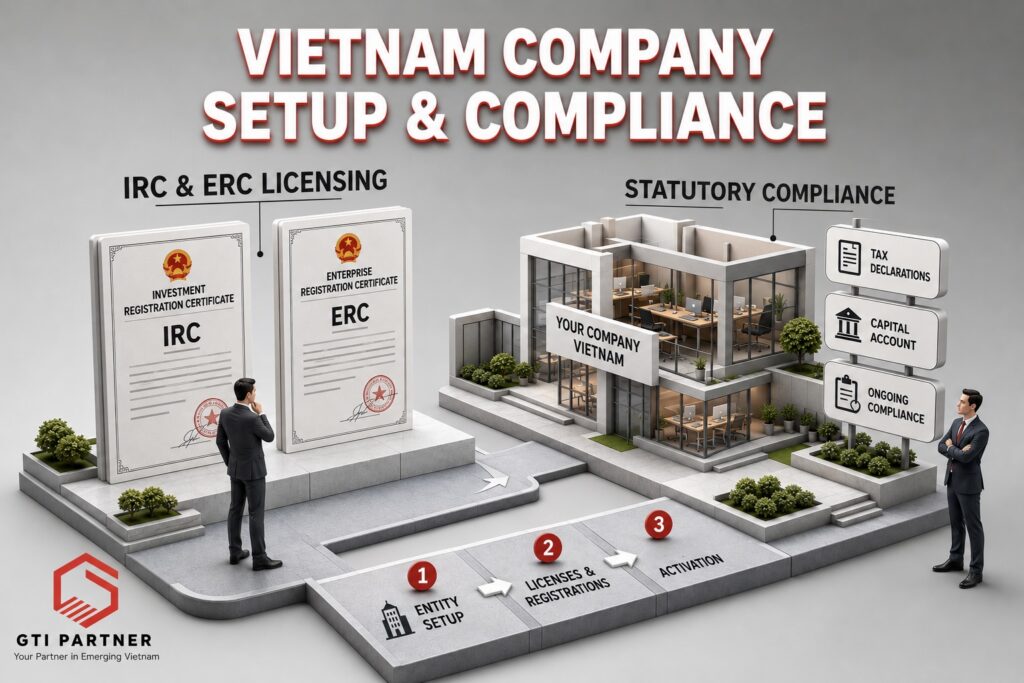
Under the previous framework, most foreign investors were required to obtain an Investment Registration Certificate (IRC) before they could establish a company in Vietnam. Only after receiving the IRC could they apply for an Enterprise Registration Certificate (ERC) to form the legal entity.
This process often delayed market entry because investors had to secure project approval before they could even create a local corporate structure.
The 2026 law reverses that traditional order.
Foreign investors can now establish an economic organization first by obtaining an ERC and then apply for the IRC afterward for the specific investment project.
This technical change has direct practical benefits. Once the company entity exists, investors can begin important preparatory steps such as:
- Opening local operational bank accounts
- Leasing physical commercial office space
- Hiring initial management and staff
- Setting up internal corporate governance structures
- Signing preliminary commercial contracts
Previously, these essential actions were difficult or impossible to execute without an active legal entity on the ground.
Vietnam Market Entry Readiness Guide
Fewer Conditional Business Lines
Another notable reform is the targeted reduction of regulated operational sectors.
The new law removes approximately 38 conditional business lines, meaning companies operating in those specific sectors will no longer face additional specialized licensing requirements beyond normal business registration.
While final implementation details vary by industry sector, this change is part of a broader effort by Vietnam to reduce administrative barriers and align its regulatory environment with international investment standards.
For foreign investors, fewer conditional sectors translate into:
- Simpler corporate compliance requirements
- Faster licensing and setup procedures
- Clearer market access rules
Clearer Investment Approval Rules
The 2026 framework clarifies which large-scale projects require investment policy approval from higher government authorities.
Instead of relying primarily on institutional authority levels, the law defines specific categories of projects that require higher approval, creating greater predictability for investors evaluating strategic or large-scale investments.
For many businesses, this modification means fewer surprises during the licensing phase and clearer expectations regarding regulatory oversight.
A More Streamlined Legal Framework
The new Law on Investment reflects a broader effort to modernize Vietnam’s regulatory landscape.
Compared with the previous 2020 law, the new framework is shorter and more direct, reducing the total number of articles from 77 down to 52.
This structural simplification reduces procedural complexity, modernizes regional investment governance, and helps attract higher-quality foreign direct investment (FDI).
Vietnam’s leadership has made clear that improving the localized business environment is central to maintaining the country’s strong economic growth and competitiveness within Southeast Asia.
What Vietnam Investment Law 2026 Means for Foreign Investors
For companies considering expansion into Vietnam, the new law sends an encouraging signal.
Vietnam is moving toward a more flexible and business-friendly investment regime, particularly for foreign investors establishing new local operations.
The new sequencing of company formation and investment approval may shorten market entry timelines and allow companies to prepare their local operations much earlier in the process.
However, investors must also note that:
- Standard market access conditions for foreign investors still apply
- Certain strategic sectors remain restricted or subject to strict ownership caps
- Local implementing regulations will continue to define how the new rules are applied in daily practice
In other words, while the process is more efficient, strategic planning and accurate regulatory guidance remain essential.
Vietnam Is Competing for High-Quality Investment
Vietnam is actively competing for global investment alongside other regional hubs. Across Asia, governments are continuously adjusting regulatory frameworks to attract technology firms, manufacturing supply chains, and international service providers.
The 2026 Investment Law reforms reflect Vietnam’s commitment to staying competitive. By reducing procedural barriers and clarifying investment rules, the country is positioning itself as a predictable and accessible destination for foreign capital.
For companies evaluating Southeast Asia as their next expansion destination, the message is clear: the country is actively making it easier to enter its market.
Vietnam Market Entry Packages: A Practical Approach for SMEs

Related posts


The Vietnam JV Governance Manifesto: Why “Legal Incorporation” Is Not Operational Control
The Vietnam JV Governance Manifesto: Why “Legal Incorporation” Is Not Operational Control Many foreign SMEs

3 Hidden Vietnam Market Entry Bottlenecks (Fix Your Strategy)
3 Hidden Vietnam Market Entry Bottlenecks (Fix Your Strategy) Many foreign SMEs view Vietnam through