
Vietnam 2026 CIT Law: How Digital Presence Impacts Foreign SMEs
25/03/2026
Vietnam 2026 CIT Law: How Digital Presence Impacts Foreign SMEs
The Vietnam CIT 2026 tax framework marks a major shift from “pre-approval” to “post-inspection” (hậu kiểm). With the Law on Corporate Income Tax (CIT) 2025 and Circular 20/2026/TT-BTC now in full effect, foreign SMEs must navigate a radically different tax environment. Whether you are an e-commerce platform or a high-tech manufacturer, the definition of doing business in Vietnam has expanded and the incentives for those who comply have never been more attractive.
Vietnam CIT 2026 Tax and Digital Presence
The Vietnam CIT 2026 tax redefine what it means for foreign companies to operate in Vietnam. For years, many foreign tech companies operated in a gray zone without a local entity. As of 2026, that door has closed.
- Broadened Permanent Establishment (PE): Any foreign entity generating income through digital platforms or e-commerce is now legally a taxpayer in Vietnam, regardless of physical office space. Under the Vietnam 2026 CIT law digital presence rules, even companies without a physical presence may now be treated as taxable entities in Vietnam.
- The 2% Rule: Non-resident sellers are now subject to a simplified 2% tax on sales proceeds for capital transfers, replacing the complex 20% net gains tax.
This aligns with our guide on Representative Office in Vietnam vs. Company Registration as the “Digital PE” rules may make an RO less viable for tech sales than a full LLC.
Vietnam CIT 2026 Tax Rates: A Win for SMEs
Alongside the Vietnam CIT 2026 tax, the government introduced tiered tax rates to support SMEs. The most significant change in March 2026 is the formalization of tiered CIT rates to support the private sector:
- 15% CIT Rate: For enterprises with annual revenue below 3 billion VND (~$114,000).
- 17% CIT Rate: For enterprises with revenue between 3 billion and 50 billion VND.
- Standard 20% Rate: Still applies to all other entities not meeting SME criteria.
Pro Tip: Under the new Decree 20/2026/ND-CP, first-time registering SMEs may even qualify for a 3-year CIT exemption from the date of their Enterprise Registration Certificate (ERC).
New Compliance Landmines to Avoid
Compliance under these rules is no longer just about invoices – it now focuses on how transactions are structured and recorded.
- The 5 Million VND Threshold: Previously, only transactions above 20 million VND required non-cash payment. Under Decree 320/2025, this has been slashed to 5 million VND (~$190). Any cash payment above this limit is now non-deductible.
- R&D Super-Deduction: To encourage innovation, the 2026 law allows a 200% deduction on qualified R&D expenses.
See our breakdown of Cost of Setting Up a Company in Vietnam to see how these R&D incentives can offset your initial burn rate.
Investment Law 2026: The “Green Lane”
The new Investment Law has introduced a “Green Lane” for projects in high-tech, semiconductors, and the “circular economy.”
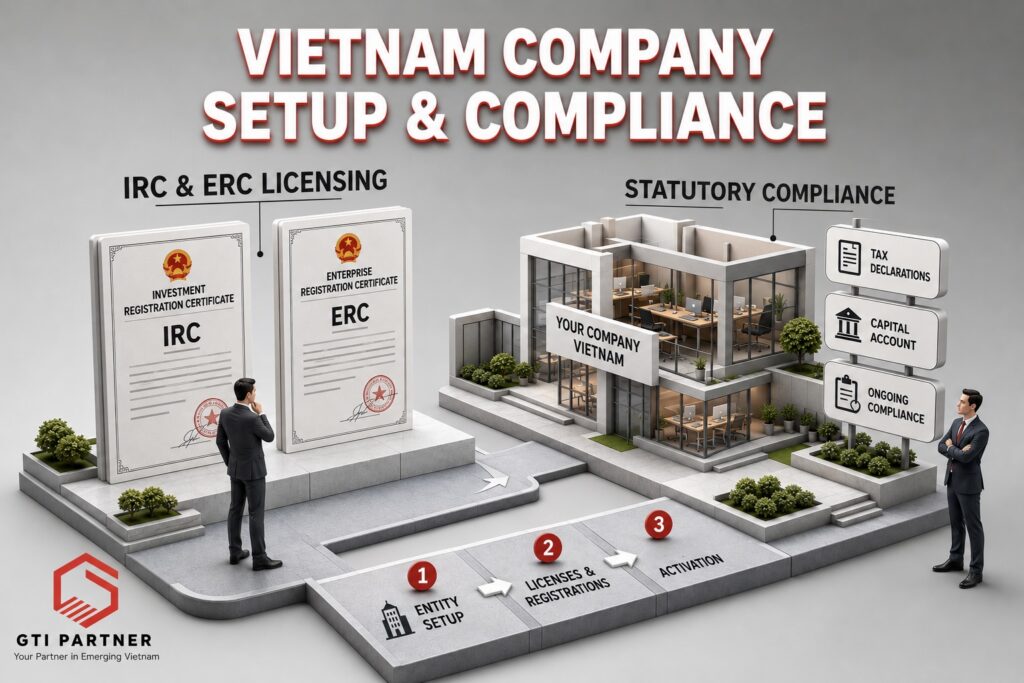
- ERC before IRC: Foreign investors can now receive their Enterprise Registration Certificate (ERC) before the Investment Registration Certificate (IRC) in certain sectors, allowing for faster bank account setup and early hiring.
For official legal text, refer to the Vietnam Ministry of Planning and Investment (MPI) portal.
Strategic Comparison: 2025 vs. 2026
| Feature | 2025 Framework | 2026 Framework (Current) |
| SME Tax Rate | Fixed 20% | 15% – 17% (Tiered) |
| Non-cash Limit | 20 million VND | 5 million VND |
| Digital Sales | Selective enforcement | Mandatory PE Registration |
| Investment Order | IRC first, then ERC | ERC first (in selected sectors) |
Conclusion: Why Today is the Day to Act
The Vietnam CIT 2026 tax framework is built to clean up the market while rewarding transparent investors. The move to digital self-declaration gives authorities real-time visibility into transactions.
Check the General Department of Taxation (GDT) E-portal for the new 2026 digital filing forms.
Ready to Navigate the 2026 Reforms?
Don’t let the new 5 million VND threshold or Digital PE rules catch your business off guard. Our team at GTI Partner is currently helping many foreign SMEs transition to the new 2026 compliance standards.
Book A 2026 Strategy Consultation Today

Related posts

Vietnam IT Outsourcing: How AI is Transforming the Industry
Vietnam IT Outsourcing: How AI is Transforming the Industry The landscape of Vietnam IT outsourcing

Vietnam Industrial Parks 2026: The Strategic FDI Playbook
Insights from the IMC 2026 keynote panel on navigating site selection, technical commissioning, and ESG

Ready-built factories vs greenfield land acquisition: Choosing the right model in Vietnam
Ready-built factories vs greenfield land acquisition: Choosing the right model in Vietnam When expanding manufacturing

Vietnam’s next generation of industrial parks: What foreign investors need beyond land and infrastructure
Vietnam’s next generation of industrial parks: What foreign investors need beyond land and infrastructure When
Company registration in Vietnam under the 2026 investment law
Company registration in vietnam under the 2026 investment law Starting a business in Southeast Asia