Corporate Governance in Vietnam: A Guide to Reserved Matters
27/05/2026
Corporate Governance in Vietnam: Reserved Matters Guide
Entering the Vietnam market is a strategic milestone for any international SME. As you outline your incorporation strategy, mastering corporate governance in Vietnam is essential to protecting your capital. There is often a natural urge to require unanimous consent for every decision, but for SMEs, this “unanimous” approach is a frequent and costly pitfall.
Effective governance is not about vetoing everything; it is about vetoing the right things. This guide explains how to design a “Reserved Matters” framework that secures your investment while keeping your Vietnam operations agile.
This article is a specialized component of our FDI Control Framework. For a holistic view on protecting your assets, intellectual property, and operational independence, please refer to our master framework.
Statutory Thresholds for Corporate Governance in Vietnam
Vietnam’s Law on Enterprises provides default voting thresholds (typically 50% – 65%). These are rarely sufficient for foreign SMEs. You must codify your rights in the Shareholders’ Agreement (SHA) to cover critical areas, rather than relying on default statutory rules.
Essential Veto Rights for Corporate Governance in Vietnam
To secure your corporate footprint, your SHA and Charter must list specific actions as reserved matters. We recommend prioritizing these categories:
- Capital Alterations: Any future dilution or modification to equity classes.
- Debt Limits: Restricting local boards from taking on liabilities above a specific threshold.
- IP Licensing: Controlling how your proprietary trademarks and technology are used.
- Key Appointments: Exclusive right to appoint or veto the General Director and Legal Representative.
Deadlock Resolution Mechanics for Corporate Governance in Vietnam
Strong governance is necessary, but it increases the risk of corporate deadlock. Proven mechanical clauses include:
- Chairman’s Casting Vote: Appointed by the foreign parent company.
- Escalation Protocols: Mandatory negotiation between parent company CEOs within 14 days.
- Shotgun Clauses: Buy-out mechanisms triggered by persistent stalemate.
Comprehensive Guide Available
This article is part of our definitive 2026 series on Vietnam market entry.
How GTI Partner Secures Your Investment
We specialize in structuring governance to meet both international standards and local requirements. Our advisors help you build a framework designed for both protection and performance.
Related posts

Vietnam’s next generation of industrial parks: What foreign investors need beyond land and infrastructure
Vietnam’s next generation of industrial parks: What foreign investors need beyond land and infrastructure When
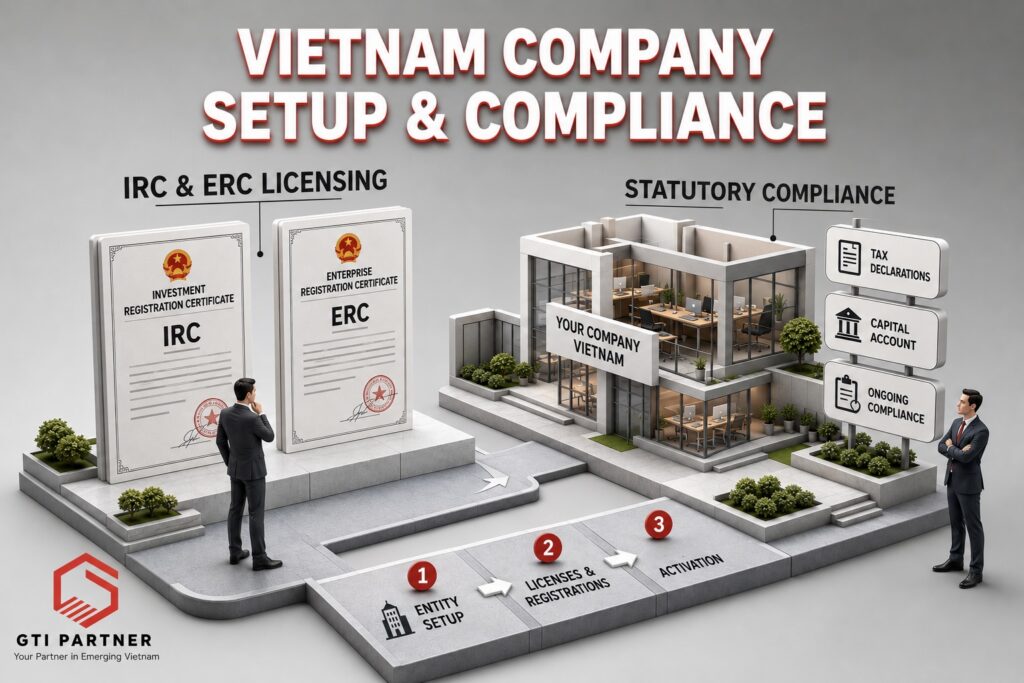
Company registration in Vietnam under the 2026 investment law
Company registration in vietnam under the 2026 investment law Starting a business in Southeast Asia
LLC vs JSC in Vietnam: Which Corporate Structure is Best for Foreign Investors?
LLC vs JSC in Vietnam: Which Corporate Structure is Best for Foreign Investors? Evaluating LLC
Vietnam Market Entry Strategy: 2026 Mistakes to Avoid
Vietnam business entry errors: 2026 Mistakes to Avoid Expanding your business into Southeast Asia requires