
Vietnam Investment Law 2026: How the New “ERC-First” Model Speeds Up Market Entry
13/04/2026
ERC-First Licensing: Vietnam Investment Law 2026 Guide
For foreign SMEs, the Vietnam Investment Law 2026 represents the most significant shift in business licensing in over a decade. As of March 1, 2026, the traditional approach has been replaced by a streamlined framework. Understanding ERC-First licensing is now a competitive necessity for market entry.
Navigating Regulatory Shifts via ERC-First Licensing
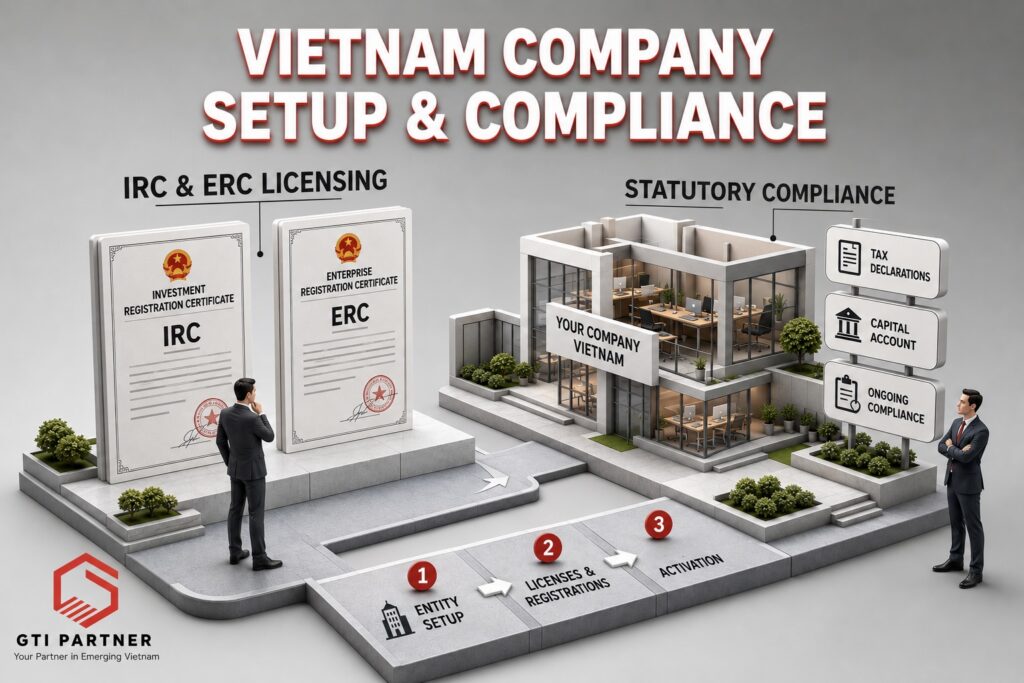
Historically, foreign investors faced a “chicken and egg” problem: you couldn’t hire staff without an Investment Registration Certificate (IRC), but getting one took months. Under the new law, the sequence is flipped for key sectors, allowing you to prioritize the new process to obtain your Enterprise Registration Certificate (ERC) immediately.
- Open local corporate bank accounts immediately.
- Sign binding commercial office leases.
- Begin the recruitment process for local talent.
Key Execution Shifts in ERC-First Licensing Implementation
At GTI Partner, we categorize these reforms into three pillars of effective implementation:
1. The Post-Inspection (Hậu Kiểm) Tax Shift
Vietnam has moved away from pre-approving every activity. Instead, the government mandates strict post-inspection compliance.
- The Risk: Incorrect tax structuring at the start may not be discovered until an audit years later.
- The Action: Ensure CIT compliance aligns with the 5 million VND non-cash payment threshold.
2. Removal of 38 Conditional Business Lines
The new law has slashed conditional sectors. Services like tax advisory no longer require exhaustive pre-licensing hurdles, lowering the barrier for SMEs.
3. Decentralized Approval Power
Decision-making has shifted to Provincial People’s Committees. Each province now has more autonomy to fast-track your project, making local partner strategy vital.
Execution Risks and Licensing Transparency
While the law makes the setup faster, it makes operations more transparent. With Digital Permanent Establishment rules in effect, foreign companies generating revenue via digital platforms cannot operate in a gray zone.
If you are starting a new corporate entity, read our detailed guide on company registration in vietnam to understand the step-by-step ERC and compliance process under the latest regulations.
Next Steps: Applying ERC-First Licensing Reforms
Are you ready to navigate the 2026 reforms? GTI Partner provides on-the-ground execution support to ensure your ERC-First licensing setup is compliant from day one. By adopting this model, you position your firm to scale rapidly within the updated legal landscape.

Related posts

Vietnam’s next generation of industrial parks: What foreign investors need beyond land and infrastructure
Vietnam’s next generation of industrial parks: What foreign investors need beyond land and infrastructure When
Company registration in Vietnam under the 2026 investment law
Company registration in vietnam under the 2026 investment law Starting a business in Southeast Asia
LLC vs JSC in Vietnam: Which Corporate Structure is Best for Foreign Investors?
LLC vs JSC in Vietnam: Which Corporate Structure is Best for Foreign Investors? Evaluating LLC

Vietnam Market Entry Strategy: 2026 Mistakes to Avoid
Vietnam business entry errors: 2026 Mistakes to Avoid Expanding your business into Southeast Asia requires