
Employer of Record (EOR) vs. Company Setup in Vietnam (2026 Guide)
26/10/2026
Evaluating EOR vs company setup in Vietnam is the first major structural decision for foreign SMEs entering the market in 2026. While an Employer of Record (EOR) lets you hire local staff in days without a legal entity, it does not allow you to issue local invoices or sign commercial sales contracts. Therefore, choosing the right structure early protects your budget, tax compliance, and long-term Vietnam market entry strategy.
Quick Executive Summary: Use an Employer of Record (EOR) if you only need 1 to 5 local employees for market research, software development, or supplier quality control. Choose a full company setup in Vietnam (100% Foreign-Owned LLC) if you need to invoice Vietnamese customers, import goods, sign local leases, or repatriate corporate profits.
EOR vs Company Setup in Vietnam: 2026 Comparison Table
Before committing capital, foreign executives should compare how each entry model handles hiring, taxes, and commercial operations. Specifically, the table below outlines the legal differences between an EOR, a Representative Office (RO), and a 100% Foreign-Owned LLC.
| Comparison Factor | Employer of Record (EOR) | Representative Office (RO) | 100% Foreign-Owned LLC |
|---|---|---|---|
| Launch Timeline | 1 to 2 weeks | 4 to 6 weeks | 6 to 10 weeks |
| Legal Entity Required? | No (uses third-party entity) | Yes (liaison office only) | Yes (full corporate entity via ERC) |
| Local Invoicing & Sales | Prohibited | Prohibited | 100% Permitted |
| Hire Local & Expat Staff | Yes (via EOR payroll) | Yes (direct RO payroll) | Yes (full direct control) |
| Best For | Testing the market with 1 to 5 remote staff | Long-term market research and supplier oversight | Commercial sales, manufacturing, and full operations |
When to Use an Employer of Record (EOR) in Vietnam
An Employer of Record acts as the legal employer for your Vietnamese team while you direct their daily work. Consequently, this model works well during the early exploration phase. You should choose an EOR in the following situations:
- Rapid Talent Onboarding: You found a strong local engineer, sourcing specialist, or business development manager and need to hire them within 14 days.
- Low-Risk Market Testing: You want to validate local supply chains or customer demand for 6 to 12 months before committing registered charter capital.
- Zero Administrative Overhead: The EOR vendor handles monthly Personal Income Tax (PIT), statutory social insurance, and labor contracts under the Vietnam Labor Code.
However, an EOR is strictly an HR and payroll wrapper. It does not give your parent company a legal license to conduct commercial business inside Vietnam.
Why an EOR Cannot Replace Company Registration in Vietnam
Many foreign SMEs assume they can run a full business through an EOR indefinitely. In reality, relying on an EOR for revenue-generating operations creates severe legal and tax exposure. Here is why an EOR cannot replace formal company registration in Vietnam:
- No VAT Red Invoices: In Vietnam, B2B buyers require official electronic VAT invoices (Red Invoices) to deduct business expenses. An EOR cannot issue commercial invoices on your behalf.
- Permanent Establishment (PE) Tax Risk: If your EOR employees negotiate contracts or generate sales in Vietnam for your overseas parent company, tax authorities can classify your operations as an unregistered Permanent Establishment. As a result, you face retroactive corporate tax penalties.
- No Import/Export or Sub-Licenses: Only a registered local entity listed on the National Business Registration Portal can hold customs codes, retail licenses, or factory leases.
- Weak Intellectual Property Control: Because your staff sign employment contracts with the third-party EOR vendor rather than your company, enforcing strict IP ownership and non-compete clauses is much harder.
Cost Analysis: EOR vs Company Setup for Foreign SMEs
When reviewing EOR vs company setup budgets, an EOR looks cheaper in month one, but a local LLC becomes far more cost-effective once you hire three or more employees.
- Typical EOR Pricing: EOR providers in Vietnam charge between $300 and $600 USD per employee per month, plus mandatory security deposits equal to 1 or 2 months of gross salary. For a team of 5 staff, you will spend $18,000 to $36,000 USD per year purely on agency management fees.
- Full LLC Setup Costs: Incorporating a 100% foreign-owned LLC involves a one-time setup investment and low monthly accounting compliance costs. You can review the exact government fees and legal budgets in our detailed guide on the cost of setting up a company in Vietnam in 2026.
Therefore, once your annual EOR management fees exceed the one-time cost of incorporation, staying on an EOR drains capital that belongs in your own subsidiary.
How to Transition from EOR to Full Company Setup
If you start with an EOR and decide to establish a permanent presence, transitioning your team to a Wholly Foreign-Owned Enterprise (WFOE / LLC) follows a clear 4-step legal sequence:
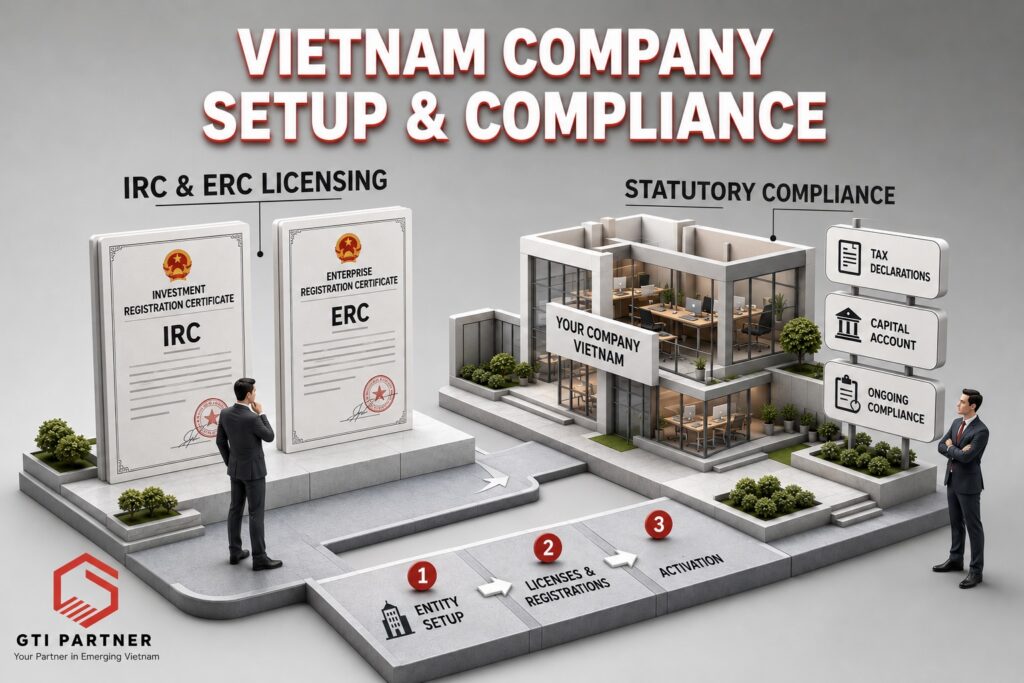
- Step 1 – Investment Approval (IRC): First, secure your Investment Registration Certificate (IRC) from the Department of Planning and Investment (DPI) to approve your foreign project scope and capital.
- Step 2 – Corporate Incorporation (ERC): Second, obtain your Enterprise Registration Certificate (ERC), which acts as your official corporate birth certificate and tax ID.
- Step 3 – Bank & Tax Activation: Next, open your Direct Investment Capital Account (DICA), inject your charter capital, and register for electronic tax and social insurance portals.
- Step 4 – Employee Transfer: Finally, terminate the EOR service agreement and sign direct Vietnamese labor contracts between your new LLC and your staff.
Frequently Asked Questions: EOR vs Company Setup
1. How many employees justify switching from an EOR to an LLC in Vietnam?
Most foreign SMEs switch from an EOR to a full company setup in Vietnam once they reach 3 to 5 employees, or as soon as they need to sign local customer contracts and issue VAT invoices.
2. Can an EOR sponsor work permits for foreign expats in Vietnam?
While some EOR providers advertise expat work permit sponsorship, Vietnamese labor authorities scrutinize third-party sponsorship heavily in 2026. Sponsoring foreign executives under your own registered LLC or Representative Office is far more reliable.
3. How long does it take to move staff from an EOR to our new company?
Once your IRC and ERC licenses are issued and your corporate bank account is active (typically 6 to 8 weeks), transferring local employees onto your direct company payroll takes 1 to 2 weeks depending on the notice period in your EOR contract.
Ready to Choose the Right Entry Model in Vietnam?
Whether you are comparing EOR vs company setup costs or preparing to file your IRC and ERC applications, GTI Partner provides transparent, end-to-end execution for foreign investors.
Related posts

Vietnam IT Outsourcing: How AI is Transforming the Industry
Vietnam IT Outsourcing: How AI is Transforming the Industry The landscape of Vietnam IT outsourcing

Vietnam Industrial Parks 2026: The Strategic FDI Playbook
Insights from the IMC 2026 keynote panel on navigating site selection, technical commissioning, and ESG

Ready-built factories vs greenfield land acquisition: Choosing the right model in Vietnam
Ready-built factories vs greenfield land acquisition: Choosing the right model in Vietnam When expanding manufacturing

Vietnam’s next generation of industrial parks: What foreign investors need beyond land and infrastructure
Vietnam’s next generation of industrial parks: What foreign investors need beyond land and infrastructure When
Company registration in Vietnam under the 2026 investment law
Executing a compliant company registration in Vietnam requires obtaining your official Enterprise Registration Certificate (ERC),