
Vietnam Industrial Parks 2026: The Strategic FDI Playbook
16/09/2026
Vietnam industrial parks 2026 represent a rapidly evolving landscape where low-cost labor arbitrage is no longer the sole driver of foreign direct investment. Foreign direct investment into Vietnamese manufacturing is now dictated by speed-to-market, regulatory certainty, grid stability, and stringent global ESG compliance. For foreign SMEs and multinational enterprises, understanding this shift is vital for successful Vietnam market entry discovery.

At the International Manufacturing Congress (IMC 2026) in Hanoi, GTI Partner led the keynote panel discussion on next-generation industrial ecosystems. Bringing together leading perspectives across industrial real estate brokerage, precision engineering, supply chain intelligence, and carbon accounting, the discussion surfaced a critical reality: the gap between leasing an industrial property and successfully achieving commercial operation in Vietnam is widening for unprepared investors.
1. Site Selection and Vietnam Industrial Parks 2026 Corridors
The historical playbook of securing prime acreage within 45 minutes of Hanoi’s urban center faces physical and economic constraints. Industrial land occupancy across core hubs like Bac Ninh, Hung Yen, and Hai Duong has reached historic highs, driving land rental rates upward.
- Tier-1 Established Hubs: Bac Ninh, Hai Phong, and Hai Duong offer mature supplier ecosystems and established customs processing, though high land premiums and constrained power allocations require high value-add margins.
- Tier-2 Expansion Corridors: Quang Ninh, Thai Nguyen, Phu Tho, and Ha Nam provide substantial land banks and municipal tax incentives, balancing raw capital expenditure against internal talent pipeline requirements.

2. Technical Commissioning & Permitting Bottlenecks
A signed lease agreement does not equal an operational factory. The most substantial risks foreign manufacturers encounter occur during technical permitting and commissioning.
- Fire-Fighting Approvals: Rigorous statutory compliance under QCVN standards requires exact engineering from inception.
- Environmental Licensing: Mandates compliant on-site pre-treatment systems under the Law on Environmental Protection.
- Power Reliability: Due diligence must verify localized substation capacity through Vietnam Ministry of Planning and Investment guidelines and utility allocations.
3. Supply Chain Clustering & ESG Mandates
Modern Vietnam industrial parks 2026 models are transitioning into Eco-Industrial Parks (EIPs). Compliance with international standards such as the EU Carbon Border Adjustment Mechanism (CBAM) and Corporate Sustainability Due Diligence Directive (CSDDD) requires green building credentials, renewable energy access, and transparent carbon tracking.
To evaluate your expansion strategy, explore GTI Partner’s professional Vietnam market entry services and secure expert advisory on the ground.
Related posts
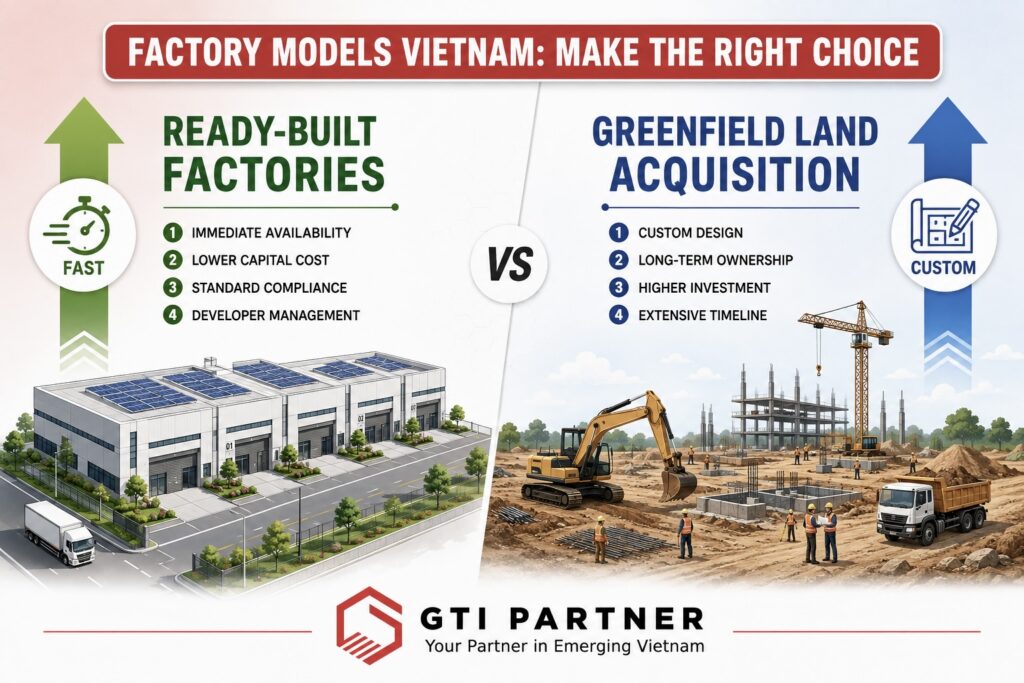
Ready-built factories vs greenfield land acquisition: Choosing the right model in Vietnam
Ready-built factories vs greenfield land acquisition: Choosing the right model in Vietnam When expanding manufacturing

Vietnam’s next generation of industrial parks: What foreign investors need beyond land and infrastructure
Vietnam’s next generation of industrial parks: What foreign investors need beyond land and infrastructure When
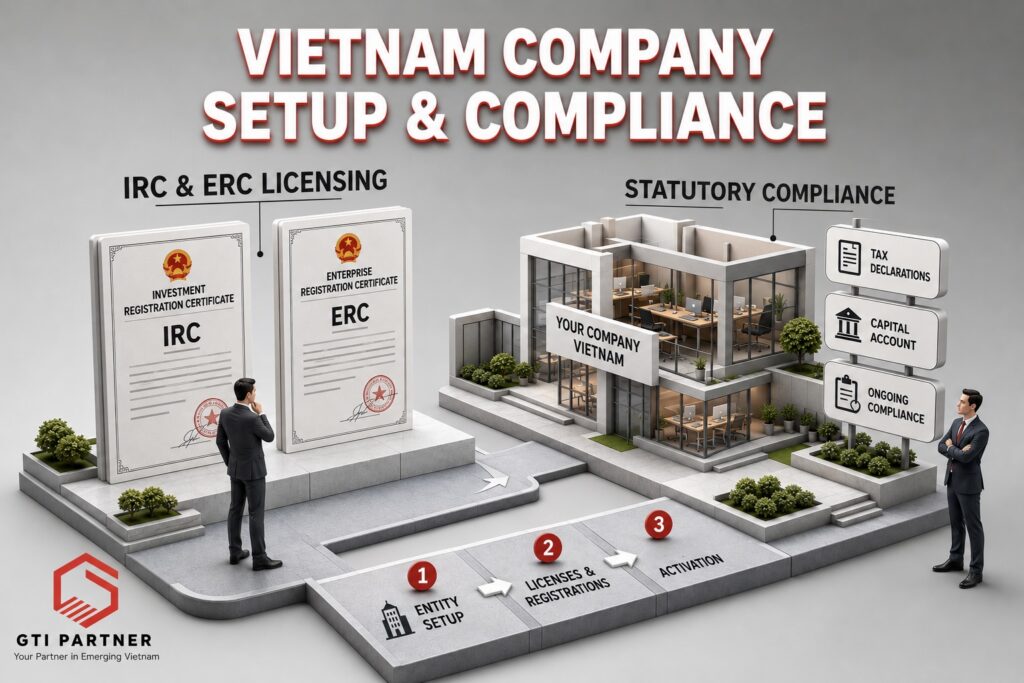
Company registration in Vietnam under the 2026 investment law
Company registration in vietnam under the 2026 investment law Starting a business in Southeast Asia
LLC vs JSC in Vietnam: Which Corporate Structure is Best for Foreign Investors?
LLC vs JSC in Vietnam: Which Corporate Structure is Best for Foreign Investors? Evaluating LLC
Vietnam Market Entry Strategy: 2026 Mistakes to Avoid
Vietnam business entry errors: 2026 Mistakes to Avoid Expanding your business into Southeast Asia requires