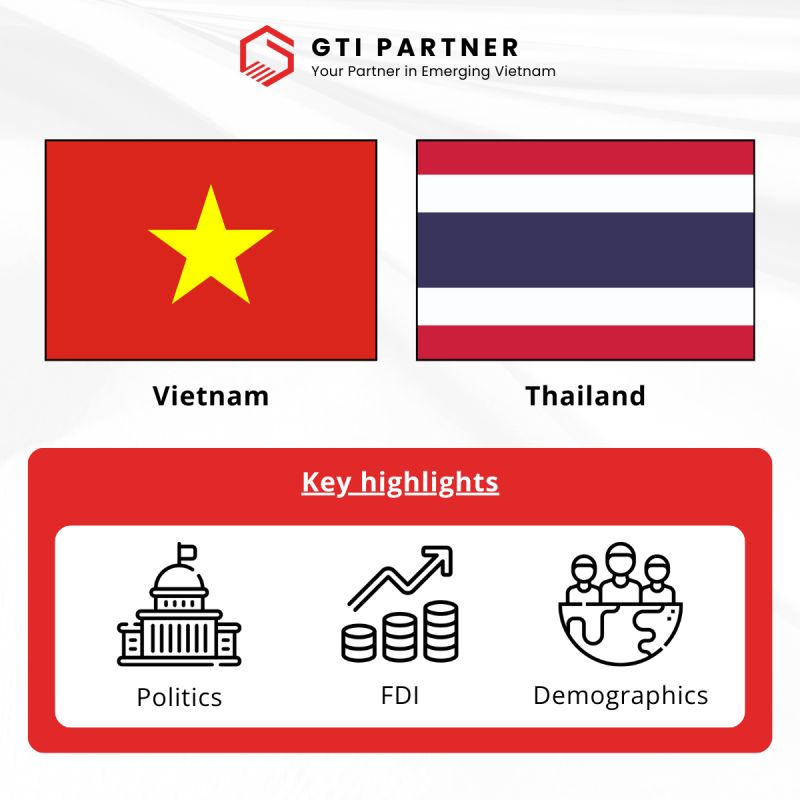
Vietnam vs. Thailand 2025: Where Should SMEs Bet on Growth?
25/08/2025
ASEAN remains one of the fastest-growing regions in the world, with Vietnam and Thailand standing out as two of the most attractive destinations for foreign investors and small and medium-sized enterprises (SMEs) seeking to expand into Asia. Both countries offer unique advantages, but also distinct regulatory and logistical challenges. For international businesses planning their next strategic move, the core question is clear: Vietnam or Thailand?
Why Businesses Choose Vietnam or Thailand for Market Entry
When executing a cross-border expansion strategy, choosing between vietnam or thailand requires analyzing macroeconomic indicators, local human capital costs, trade frameworks, and infrastructure development. Both nations present distinct operating models for international growth tracks.
1. Economic Outlook: Growth Momentum
- Vietnam: Projected GDP growth of 5.5% to 6.5% annually through 2030, strongly driven by electronics exports, a scaling digital economy, and robust Foreign Direct Investment (FDI) inflows.
- Thailand: Moderate, stable growth patterns around 3% to 3.5%, supported heavily by international tourism recovery, multi-year state infrastructure projects, and domestic consumer consumption.
- SME Takeaway: Choosing vietnam or thailand comes down to your growth velocity goals. Vietnam offers rapid economic acceleration tracks, while Thailand provides established commercial stability and a diversified consumer economy.
2. Investment Climate and Corporate Incentives
- Vietnam: Aggressive corporate income tax incentives for high-tech setups, renewable energy projects, and specialized manufacturing sectors, backed by deep integration into major global networks like the EVFTA, CPTPP, and RCEP.
- Thailand: Highly structured Board of Investment (BOI) incentives offering tax holidays, 100% foreign corporate ownership in approved industries, and strategic logistics hubs optimized for ASEAN-wide physical distribution.
- SME Takeaway: Vietnam holds a clear advantage for global tariff-free export market access. Thailand functions as an excellent base for regional corporate headquarters and complex logistics coordination.
3. Labor Force Dynamics and Operational Costs
- Vietnam: Highly cost-competitive, youthful, and technically adaptive workforce, making it the premier choice for manufacturing integration and tech-driven outsourced teams.
- Thailand: Higher statutory minimum wages and overall corporate compensation requirements, but paired with a deeply experienced local talent pool in advanced engineering, industrial management, and premium services.
- SME Takeaway: Vietnam provides structural baseline operational cost savings, whereas Thailand delivers specialized technical expertise in mature industrial sectors.
4. Infrastructure Development and Supply Chain Security
- Vietnam: Rapidly expanding industrial parks, deepwater seaports, and highway networks, though still navigating regional utility grid capacity challenges and port congestion during peak trade cycles.
- Thailand: Highly mature physical infrastructure networks, seamless connectivity across mainland Southeast Asia, and sophisticated, established third-party logistics (3PL) distribution ecosystems.
- SME Takeaway: While Vietnam’s infrastructure is catching up at an aggressive rate, Thailand offers immediately reliable, turnkey supply chain and distribution mechanics.
5. High-Growth Sector Opportunities
- Vietnam: High-value electronics, semiconductor packaging, textiles, green energy development, software outsourcing, and consumer e-commerce.
- Thailand: Automotive manufacturing, advanced electric vehicles (EV), medical tourism, healthcare services, and automated food processing.
- SME Takeaway: Your target industry vertical will naturally dictate whether vietnam or thailand is the optimal operational fit for your expansion.
Choosing the Right Fit for Your Corporate Strategy
Both destinations present exceptional investment tracks for expanding enterprises. Vietnam is structurally optimized for manufacturing hubs, export-driven enterprises, and cost-sensitive production operations. Conversely, Thailand serves as a premium launchpad for regional distribution networks, complex business services, and highly specialized industrial operations.
For forward-thinking corporate planners, the ideal approach may look beyond choosing one over the other. Deploying a integrated “Vietnam + Thailand” strategy allows your organization to capture Vietnam’s sheer growth velocity while anchoring logistics, warehousing, and treasury management within Thailand’s mature commercial infrastructure.
Related posts

Vietnam’s next generation of industrial parks: What foreign investors need beyond land and infrastructure
Vietnam’s next generation of industrial parks: What foreign investors need beyond land and infrastructure When
Company registration in Vietnam under the 2026 investment law
Company registration in vietnam under the 2026 investment law Starting a business in Southeast Asia
LLC vs JSC in Vietnam: Which Corporate Structure is Best for Foreign Investors?
LLC vs JSC in Vietnam: Which Corporate Structure is Best for Foreign Investors? Evaluating LLC
Vietnam Market Entry Strategy: 2026 Mistakes to Avoid
Vietnam business entry errors: 2026 Mistakes to Avoid Expanding your business into Southeast Asia requires